Who is the importer in a DDP shipment? Why the VAT is not yours to reclaim
When the first invoice for a door-to-door shipment with duties and taxes included arrives, a question comes up that almost nobody asks when booking: “and where is my customs document?”. There isn’t one in your name. That is not sloppiness on the forwarder’s side: it is how the service works.
The short answer: under DDP (Delivered Duty Paid) the import is on the seller’s account —it is the Incoterms 2020 rule: the seller clears the goods for import and pays the duties (ICC)—, and in practice that role falls to the freight forwarder or the agent clearing on its behalf. The declaration is filed in that party’s name, not in the end customer’s. The customer gets the goods at the door and an invoice for the service; the customer does not get an import declaration of their own.
What being the importer actually means
Being the importer is not a decorative title: it is the legal position from which you answer for the operation. Whoever appears on the declaration takes on, among other things:
- The tariff classification of the product and the code it enters under.
- The customs value declared, which is the base for duty and VAT.
- Payment of duties and taxes at the time of clearance.
- The documentation the goods require (certificates, licences, declarations of conformity).
- Keeping the records of that operation for as long as the law requires.
And to file that declaration you need to be fiscally identified in the destination country: an economic operator number (EORI in the European Union, other figures in other markets) and, in most cases, a local tax identification or a fiscal representative. A private individual, or a company that has never imported, normally has neither.
What you gain from DDP
It is not a small thing, which is why it sells so well:
- One contact and one invoice, with the total cost delivered to your warehouse.
- No paperwork: you do not deal with customs, you do not advance taxes, you do not appoint an agent.
- No unpleasant surprises: if the duty or the tax turns out different from what was expected, that is not your problem.
- It works for testing a product or for a first import before you build your own setup.
What you give up when the importer is someone else
This is the part that is rarely spelled out.
- You have no declaration of your own. If your accountant asks for the import document, there is nothing in your name.
- Import VAT does not pass through your books. The importer pays it at customs and reclaims it in its own return —provided it is a business entitled to deduct—, because the law designates the importer as the debtor of that amount. You do not bear it, so you have nothing to reclaim either: it is not that it is given to you for free, it is that the amount never reaches your name. If you are a business entitled to deduct, the effect is neutral; where the outcome really changes is in countries where the tax is only credited if the declaration is in your name, because there DDP costs you the tax in full.
- You cannot claim tariff preferences or use a quota: you are not the holder of the declaration.
- You cannot appeal a classification or a value you believe is wrong: the appeal belongs to whoever declared.
- Product liability stays with the importer, including marking, labelling and destination-country obligations. As a distributor you keep your own traceability duties.
- You depend on the other party’s paperwork. If you later need to prove the origin or the value of those goods, you will have to ask for it.
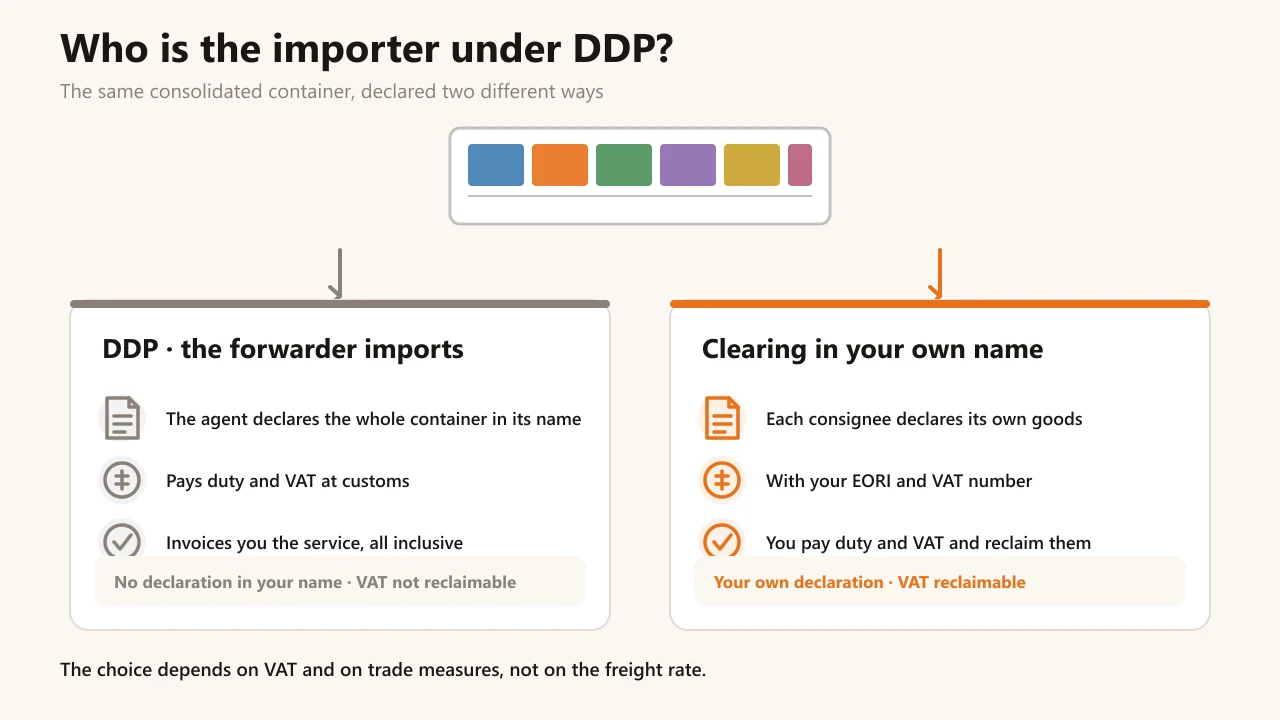
DDP · importer: the forwarder
- One invoice, one contact, no formalities
- Import VAT is settled and reclaimed by the importer
- No declaration in your name
- No preferences, no appeals of your own
- Simple and fast to get started
Clearing in your own name
- You need import tax identification in the destination country
- The VAT or the equivalent tax is settled in your name
- You hold the declaration and the records
- You can claim preferences and appeal
- More formalities and more responsibility
Quick rule: clear in your own name if you need the declaration to credit the tax, if the goods are subject to anti-dumping duties, quotas or licences, or if the product requires you to be the responsible party. If what you want is to test, move small volumes or not build a structure, DDP with the forwarder as importer is perfectly valid.
How this looks in each market
The underlying question is always the same —who appears as the importer?—, but every customs administration has its own vocabulary and its own way of settling the tax:
- European Union. For import VAT, the debtor is whoever the rules of each Member State designate, which in practice is the importer appearing on the declaration; and that same party is the one who can deduct it afterwards, provided the goods are used for taxed transactions (Directive 2006/112, arts. 201 and 168).
- United Kingdom. Postponed VAT accounting lets you declare and recover the VAT in the same return instead of paying it at the border, but the one doing it is the importer with its EORI and its VAT number. If someone imports in your name, they have to use yours and have your written instruction (HMRC).
- United States. There is no VAT to recover: duties, excise taxes and fees are settled at customs, and sales tax appears, if it appears at all, in the domestic sale (CBP). Here the tax argument weighs less and traceability and liability weigh more.
- Mexico. The 2022 tax reform revisited the VAT treatment of customs operations carried out on behalf of third parties — precisely the DDP scenario with a third-party importer — with a stricter criterion for crediting (professional analysis). It is the market where this model has generated the most tax discussion in recent years.
In every case the check is the same: look at the import declaration and see who appears. If you are not there, you have no document of your own and no credit in your name.
When each one fits
DDP with the forwarder as importer works when the volume is small, when the tax is not an issue for you (because you would not recover it anyway) or when it is your first operation and you want to see how everything works before setting up your own circuit.
You need to clear in your own name in these cases:
- The tax is only credited with your name on the declaration, as happens in Mexico: if you do not appear, you pay it without being able to recover it.
- The goods carry special trade measures: anti-dumping duties, quotas or licences that only the importer can use.
- The product is regulated and requires the importer to be the responsible party (food, cosmetics, electrical equipment, toys, medical devices).
- You are going to re-export or sell to another country and need to prove the customs status of the goods.
- Your accounting or your auditor asks for the import document.
The middle option is DAP: we take the goods to your door, but you clear the import with your import tax identification and pay duty and VAT at customs. Then you do have your own declaration. The difference with DDP is not about transport, it is about who the importer is.
How we handle it
In our door-to-door service DDP works as described: we import in our agent’s name and deliver with everything included. If you need the declaration in your own name, we set it up as a different operation — usually with your own import clearance — and the price changes, because who answers for the goods and who pays the taxes changes.
What matters is deciding it before booking, not when the invoice arrives. If that is what you need, say so from the start and we prepare it that way; it also applies to sea freight in groupage or full container.
Note: customs and tax rules change and differ from one country to another. This is a general explanation, not tax advice: confirm your specific case with your adviser or with the customs agent representing you.
Got a shipment in the pipeline and not sure which set-up suits you? Tell us what you are moving, how much and where to, and we will tell you what works best in your case. Request a quote.