Services
Sea freight from China: FCL and LCL
Sea freight is the most cost-effective way to import from China and the backbone of most operations. Whether you fill a full container (FCL) or send a few boxes as groupage (LCL), we choose the route, carrier and mode that best fit your cargo.
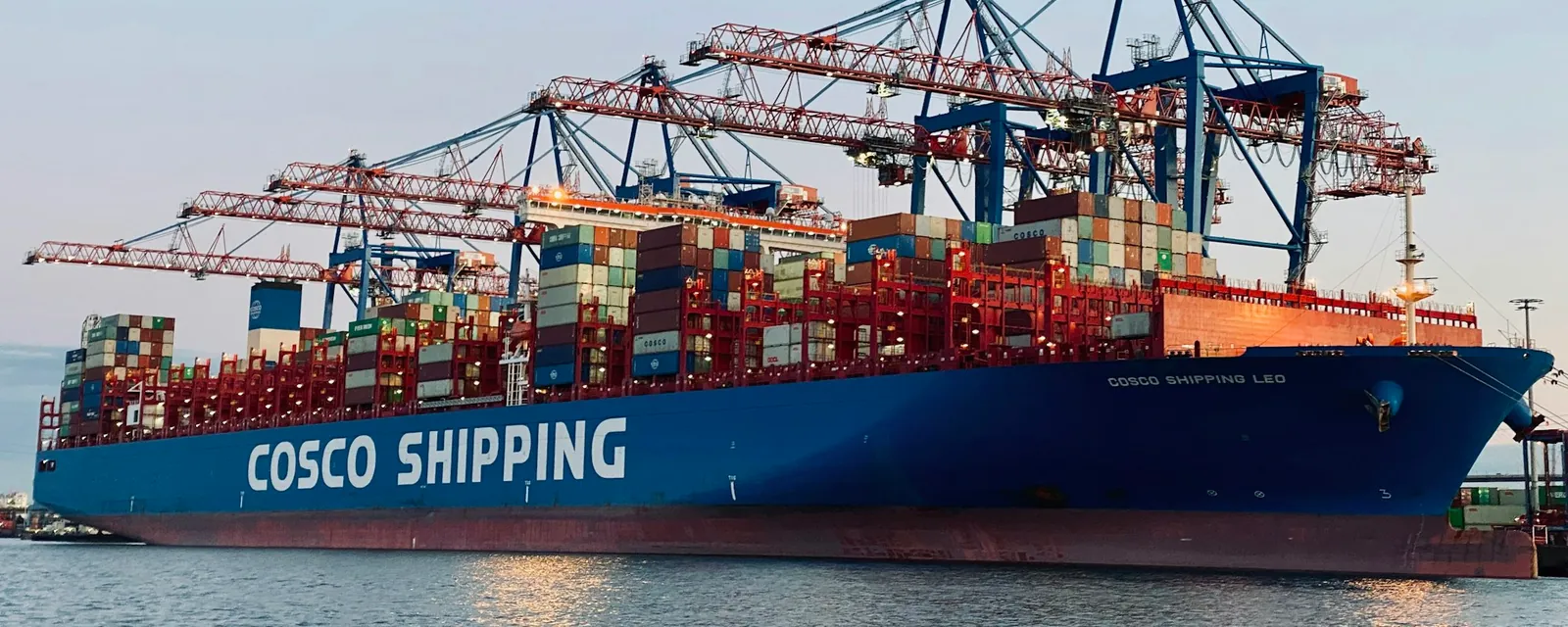
FCL vs LCL: which one suits you?
FCL — Full Container Load
You rent an entire container (20' or 40') just for your cargo. It usually pays off from around 15 CBM, or when you want to minimise cargo handling. More stable price per unit and lower risk of damage.
LCL — Groupage
Your goods share a container with other importers and you only pay for the space you use. Ideal below around 15 CBM and to start with no minimum volume. Many first trial imports travel this way.
Container types
20' Standard (20GP)
Ideal for dense or heavy cargo and mid-range volumes.
40' Standard (40GP)
The most common choice as volume grows.
40' High Cube (40HC)
Extra height for bulky, lightweight goods.
The theoretical figure is the container's geometric volume; the estimated real is what usually gets loaded, because it's rarely filled to 100%. Actual usage depends on the nature and homogeneity of the cargo (uniform, easily stackable boxes fit more) and on weight: with dense cargo —tiles, stone, liquids, metal, ink…— you'll hit the weight limit (around 26–28 t in a 40HC) before filling the volume.
Out-of-gauge cargo: special equipment
Your cargo won't fit in a closed container —a machine, an engine, an oversized piece? Not a problem: there's equipment made for exactly that. Quick rule: over-height only → Open Top; over-width → Flat Rack; if it rolls (vehicles, self-propelled machinery) → RoRo; huge and indivisible → breakbulk (general cargo).
Open Top
A standard container but without a roof (closed with a tarpaulin). Cargo is craned in from the top. Ideal when the piece fits in the box but sticks out in height. It carries an over-height surcharge.
Flat Rack
A platform with two end walls, no roof or sides. Takes pieces that are over-width or very heavy, loaded from the top or the side and lashed to the base.
Breakbulk (general cargo)
For the huge and indivisible that won't even fit on a platform: loaded piece by piece straight into the ship's hold, with its own stowage and lashing plan.
RoRo (roll-on/roll-off)
If the cargo rolls —cars, trucks, self-propelled machinery— it drives on and off RoRo vessels, no container needed.
Every out-of-gauge piece is studied case by case: dimensions, weight and lifting and lashing points. Send us the measurements and weight and we'll tell you the equipment and route that fit best.
Ports of origin and transit times
We operate from China's main ports —Shanghai, Ningbo-Zhoushan, Shenzhen, Guangzhou, Qingdao, Xiamen, among others— to over 40 destination ports. Not all factories ship from the same port: we analyse every shipment to choose the best combination of factory, port and carrier.
Indicative sea transit times from China:
- Europe: 25–35 days
- North America: 18–25 days
- Latin America: 28–38 days
- Middle East: 18–28 days
- Africa: 20–35 days
- Southeast Asia: 5–12 days
- East Asia: 3–6 days
- Oceania: 18–25 days
Sounds complicated?
We handle the transport, paperwork and customs from start to finish.
How we handle your sea shipment
- We collect at the factory and consolidate the cargo if needed.
- Export clearance in China and space booking with the carrier.
- Sea freight with vessel tracking (B/L number).
- Import clearance at destination, coordinated with the local customs agent.
- Final delivery to your warehouse, door to door if you need it.
Want to sharpen the numbers? Learn how to work out the real cost per unit (landed cost). And bear in mind that the freight doesn't cover the value of your goods — here's why cargo insurance matters.