FCL vs LCL: full container or groupage to import from China?
When you import from China by sea, one of the first decisions is how your cargo travels: in a full container (FCL) or sharing a container with other cargo (LCL). The choice directly affects the price, transit time and risk of your shipment. In this guide we explain what each option means and how to choose the one that suits you.
What FCL and LCL mean
These are two abbreviations you’ll see constantly in sea freight quotes:
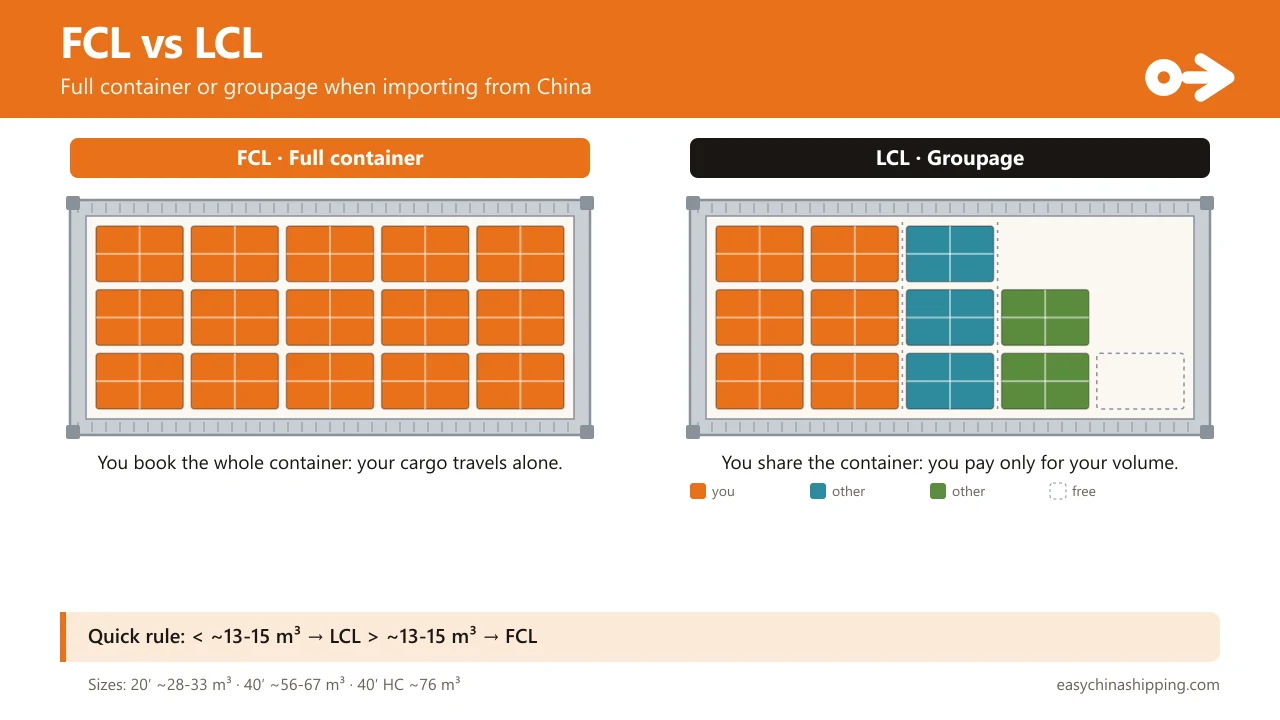
- FCL (Full Container Load) — a full container. You book a whole container for your cargo, even if you don’t fill it completely. Your goods travel alone, without mixing with anyone else’s.
- LCL (Less than Container Load) — groupage or consolidated cargo. Your goods share a container with other importers’ cargo. You pay only for the space you take up, measured in cubic metres (CBM).
The idea is simple: if you have enough cargo to make filling a container worthwhile, you go FCL; if you have little volume, groupage lets you split the cost of the container with others.
FCL · Full container
- You book a whole container for yourself
- Your cargo travels alone, no mixing
- You pay per container, full or not
- Worth it from ~13-15 m³
- Faster and with less handling
LCL · Groupage
- You share a container with other cargo
- You pay only for your volume (m³)
- Ideal for less than ~12-15 m³
- Slightly longer times (consolidation)
- More handling and billing minimums
Quick rule: below ~13-15 m³ groupage (LCL) usually wins; above that, the full container (FCL). Always compare the total port-to-port cost, not just the freight.
Container sizes (FCL)
In FCL, the most common formats are:
- 20-foot container (20’) — around 28-33 m³ of usable space, up to ~28 tonnes depending on the carrier and cargo.
- 40-foot container (40’) — around 56-67 m³ of usable space.
- 40’ High Cube (40’HC) — like the 40’ but taller, around 76 m³.
The exact figures vary by container type and weight limits. The key point: the 40’ doesn’t cost twice as much as the 20’, so when you’re close to filling a 20’, it can be worth jumping to the 40’.
When is each one worth it?
The rule of thumb revolves around volume:
LCL (groupage) suits you if…
- Your cargo is around less than 12-15 m³.
- You want to start importing with small orders and little investment.
- You’re not in a hurry: groupage usually has slightly longer transit times due to consolidation and deconsolidation.
FCL (full container) suits you if…
- Your cargo is over roughly 13-15 m³ (beyond that, filling a 20’ is usually cheaper per m³ than paying for groupage).
- Your goods are fragile, bulky or sensitive: with no container sharing, there’s less handling and less risk of damage or mix-ups.
- You want tighter transit times and simpler tracking.
There’s no universal magic number: the point where FCL beats LCL depends on current rates, the route and the weight. That’s why it’s best to compare both options for your specific shipment before deciding.
Beyond price: other differences
Cost per m³ isn’t everything. These differences also matter:
- Handling. In LCL your cargo is grouped and separated in consolidation warehouses: more handling = a bit more risk. In FCL the container is sealed at origin and opened at destination.
- Transit times. Groupage adds consolidation time at origin and deconsolidation at destination. FCL is usually more direct.
- Destination costs. In LCL there are deconsolidation charges that are worth knowing upfront so they don’t catch you out.
- Minimums. Groupage usually bills a minimum (for example, 1 m³), even if you ship less.
Common mistakes when choosing
- Looking only at the freight and forgetting destination costs. In LCL, deconsolidation charges can change the comparison a lot. Always ask for the total port-to-port cost.
- Sticking with LCL out of habit when you’re almost filling a container. If you’re around 13-14 m³, ask for an FCL price too: it may come out the same or cheaper, and with less risk.
- Not accounting for weight. Light but bulky cargo is governed by volume; very heavy cargo may hit the weight limit first. Both factors count.
- Confusing actual volume with chargeable volume. In groupage you’re billed on the greater of weight or volume, per the carrier’s rule.
In short
- LCL (groupage): ideal for small volumes and for getting started; you pay for what you take up, but with slightly longer times and more handling.
- FCL (full container): cost-effective above a certain volume, faster and safer for your goods.
- The line between the two isn’t fixed: it depends on rates, route and weight. Comparing both options for your case is what saves you money.
At EasyChinaShipping we arrange your sea import in both FCL and LCL, and we tell you with real numbers which one suits each shipment. See how our sea freight from China works, or ask us for a free quote telling us what you want to move.