Can I ship an electric vehicle from China? RoRo, LCL and container
China has become the world’s largest exporter of electric vehicles, and more and more importers ask us the same thing: “Can I bring an electric car from China, and how?” The short answer is yes, but it doesn’t travel like an ordinary car: what calls the shots isn’t the vehicle, it’s its lithium battery, which is dangerous goods. And that decides entirely how it can cross the sea. This guide clears up the three routes —RoRo, groupage (LCL) and a dedicated container— without the oversimplification of “it always ends up in a container”, which is no longer quite true.
Direct answer: an electric vehicle with a lithium battery can be shipped by sea, but the battery classifies it as Class 9 dangerous goods. New, compliant EVs usually travel by RoRo; used or standalone ones are refused by many carriers and end up in a dedicated container (FCL) with a dangerous-goods declaration. In groupage (LCL), almost never. The carrier always has the final word.
The lithium battery rules: it’s dangerous goods (Class 9)
An electric car carries a lithium traction battery that, for transport purposes, is Class 9 dangerous goods (the miscellaneous-hazards class). The reason is fire risk: a lithium battery can go into thermal runaway, a fire that burns differently from a petrol-engine fire and is very hard to put out on board a ship.
It helps to separate two situations, because they change the classification:
- Battery installed in the vehicle → the whole thing travels as a lithium-battery-powered vehicle.
- Battery on its own, out of the vehicle → it’s a lithium battery in its own right (UN3480 when shipped alone, UN3481 when it accompanies equipment), one of the most strictly regulated categories of dangerous goods.
2026 update (important): since 1 January 2026, under IMDG Code Amendment 42-24, a lithium-battery vehicle is no longer declared as UN3171. It now uses its own UN numbers by chemistry: UN3556 (lithium-ion), UN3557 (lithium-metal) and UN3558 (sodium-ion). If you find older information, you’ll see “UN3171”; the term has changed, and carriers reject mis-declared bookings.
RoRo: the normal route for new EVs, restricted for used ones
RoRo (roll-on/roll-off) is the vessel where vehicles drive on and off, no container. It’s how manufacturers export their cars, EVs included: there is an exemption in the rules (Special Provision 961) that frees the vehicle from much of the IMDG Code when it travels in an approved RoRo space and there is no leakage from battery, engine or fluids. That’s why a new, compliant EV usually travels by RoRo without issue.
The problem is with used or “standalone” EVs (a single unit an importer buys, not a factory batch). Because of the fire risk, many carriers restrict or refuse them on their RoRo vessels:
- Some lines have gone as far as suspending all electric-vehicle shipments (new and used) on safety grounds.
- Since 2026 there are stricter fire-protection regulations for RoRo vessels carrying EVs.
- When they do accept them, they usually require a low state of charge (often ≤ 30%) with signed documentation.
The takeaway: for a used EV, RoRo depends on the carrier and the route. Whoever charters the vessel —your freight forwarder— is the one who knows what each line accepts at any given time.
LCL (groupage): practically no
Groupage —sharing a container with other importers— is not a realistic option for an electric vehicle, for two reasons that stack up:
- It’s Class 9 dangerous goods, and most consolidators refuse dangerous goods in groupage (mixing incompatible cargo in one container is a risk almost nobody takes on).
- And even if they accepted it, a whole vehicle doesn’t fit in a groupage slot.
You can see when groupage makes sense —and when it doesn’t— in our guide to full container or groupage (FCL vs LCL).
Dedicated container (FCL): the compliant plan B
When RoRo won’t take the vehicle, the compliant route is its own container (usually a 20’), with its dangerous-goods declaration. A technical detail many people don’t know: the RoRo exemption (SP961) does not automatically apply when the vehicle travels inside a container. In other words, in a container the EV can fall under the full Class 9 requirements (packaging, declaration, battery conditions) —more paperwork, not less.
So, for a single unit, the maths is simple: one vehicle = one dedicated container. The price of the container is the price of moving your car, not an “extra for the spare space”. It’s cargo that’s assessed case by case, in the same family as the out-of-gauge and special-equipment cargo in sea freight.
What about shipping the battery separately?
It’s a fair question: if the battery is the problem, why not send the car one way and the battery another? You can, and it’s sometimes done, but with honest caveats:
- The standalone battery travels as UN3480, one of the strictest dangerous goods (state-of-charge limits, approved packaging, and banned on passenger aircraft).
- Removing a traction battery from a car isn’t trivial: it can affect the warranty, needs a specialist workshop and isn’t always possible.
Bottom line: splitting battery and vehicle is not a cheaper shortcut by default. It makes sense in specific cases (certain routes, or when RoRo isn’t viable), but it has to be weighed with the numbers in front of you.
At a glance: RoRo vs LCL vs container
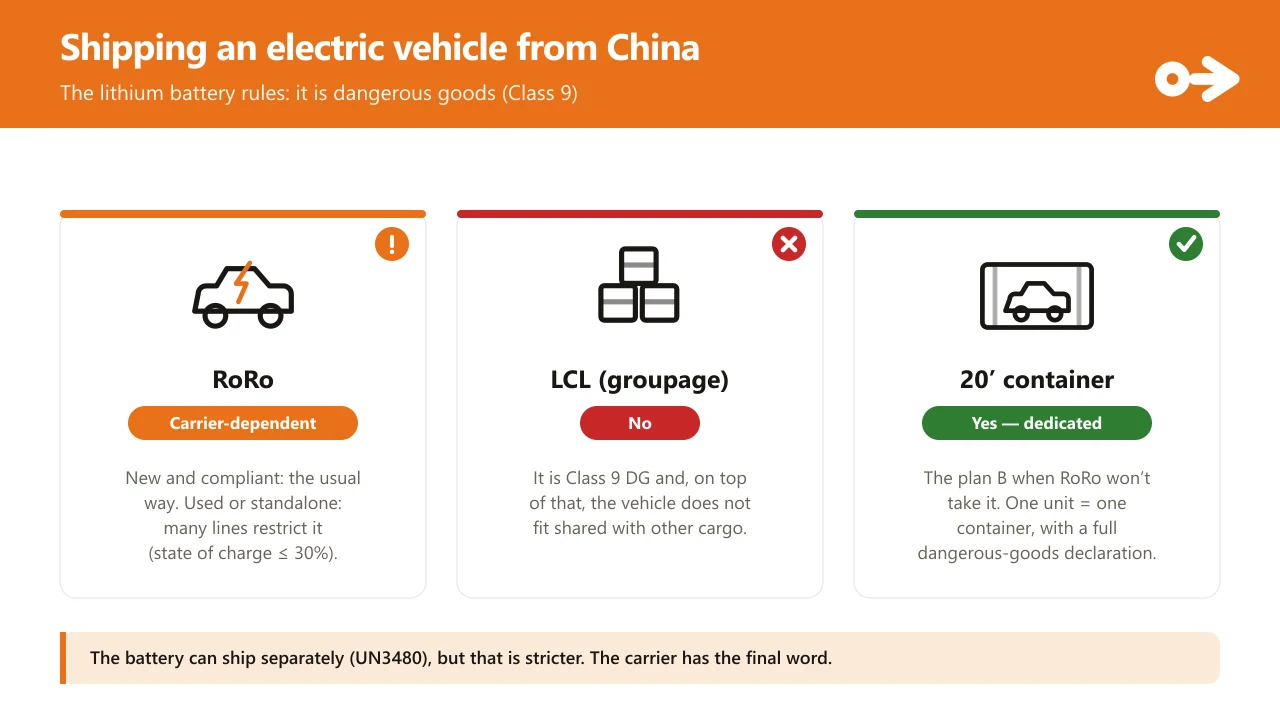
RoRo — carrier-dependent
- The normal route for new EVs that are compliant (SP961 exemption)
- Used or standalone: many lines restrict or refuse them
- Usually needs a low state of charge (often ≤ 30%)
LCL (groupage) — no
- It's Class 9 DG: consolidators rarely accept it
- A whole vehicle doesn't fit when shared
- In practice, not an option
20' container (FCL) — yes
- The plan B when RoRo won't take it
- One unit = one dedicated container
- With a full dangerous-goods declaration
What we need to quote it
To give you a real price for an electric vehicle (or its battery) we need, besides the usual details of any shipment, to know exactly what the product is —make, model, new or used— and the battery details (type and capacity). The dangerous-goods paperwork (the UN38.3 test report, MSDS/safety data sheet, state of charge) is needed too, but it’s prepared at booking, not for the first quote.
And one thing we always say honestly: with dangerous goods, the carrier has the final word. We look for the best option across the lines and tell you what each one accepts for your specific case.
In short
- The lithium battery turns the car into Class 9 dangerous goods; that governs everything else.
- RoRo: the normal route for new, compliant EVs; for used/standalone ones, it depends on the carrier (many restrict them).
- LCL (groupage): practically no (dangerous goods + doesn’t fit).
- Dedicated container (FCL): the plan B, in compliance; one unit = one container, with a dangerous-goods declaration.
- Battery separately (UN3480): possible, but stricter, not a cheap shortcut.
- Since 2026 the classification is UN3556/3557/3558 (no longer UN3171).
Note: dangerous-goods regulations and carrier policies change, and 2026 brought important changes. This guide describes the general situation at the time of writing; for your specific shipment, confirm it with your freight forwarder before booking.
At EasyChinaShipping we move dangerous goods from China —lithium batteries included— in full compliance and with no surprises. If you’re thinking of bringing in an electric vehicle or a battery, tell us about it and we’ll tell you the route and price that fit best.