Documents needed to import from China: the clear list

You can have the best supplier, an unbeatable price and the ship on time… and still watch your goods stuck at the port because a paper is missing or two figures don’t match across two documents. In international trade, the documents are the goods: without them, customs won’t clear and the carrier won’t release. The good news is that the list isn’t endless. There are three documents that always travel with any shipment, plus a handful more that show up depending on the product and the destination. This is the clear guide to the documents needed to import from China.
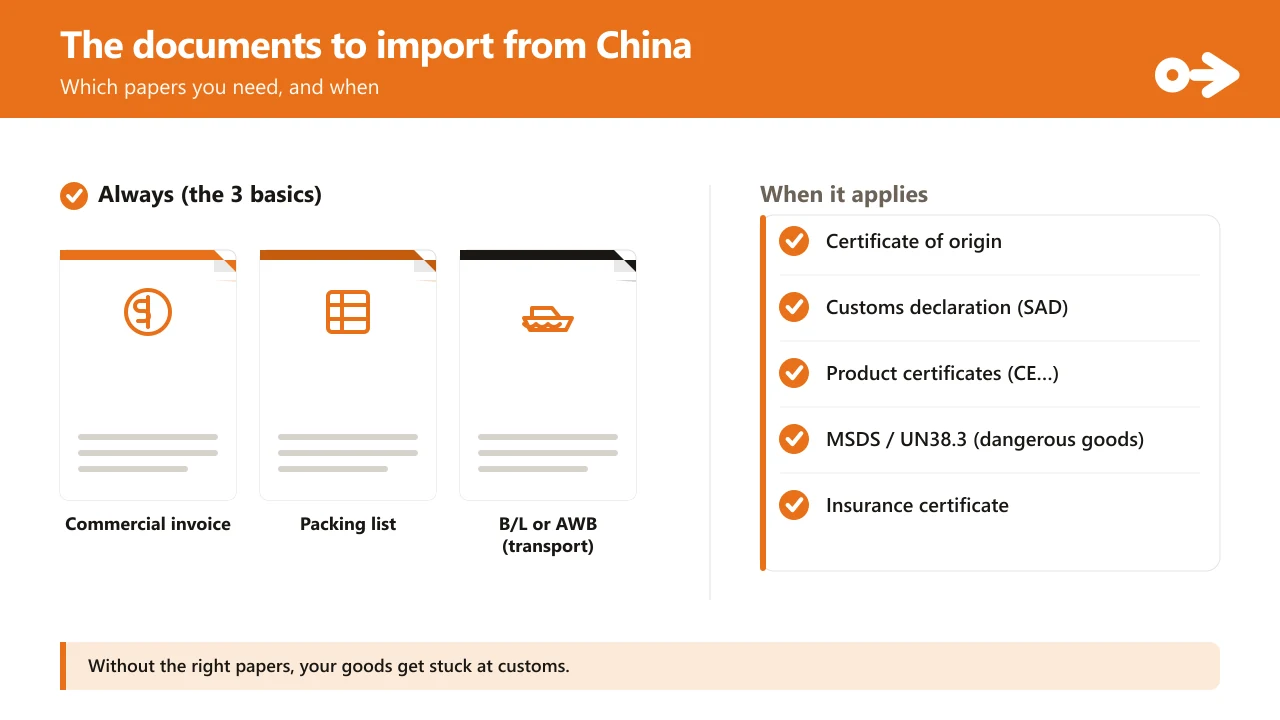
The 3 documents that always travel with your goods
Whatever the product, the country or the mode of transport, these three are never missing. They are the minimum customs needs to identify what it is, what it’s worth and how it travels.
1. Commercial invoice
This is the key document. It’s issued by the seller (your Chinese supplier) and it’s the basis on which customs calculates duties and tax. It must reflect the real transaction: who sells and who buys, the description of the goods, quantities, unit and total price, the currency, the Incoterm (FOB, EXW, CIF…) and, ideally, the HS (tariff) code of each product.
The detail that causes the most trouble is the value. Customs calculates duty and VAT on the value declared in the invoice, so under-declaring to pay less tax is fraud and can lead to inspection, penalties and seizure of the cargo. The invoice has to tell the truth.
2. Packing list
Also issued by the supplier, and it goes with the invoice. While the invoice talks about money, the packing list talks about packages: how many cartons or pallets, what each one contains, and above all the weight (gross and net) and the dimensions/volume (CBM). It’s what the carrier uses to plan the shipment, and what customs (and you) use to check that what arrives matches what was bought.
Golden rule: the invoice and the packing list must match each other (same quantities, same references). If they don’t, suspicion is triggered and clearance stalls.
3. Transport document: B/L or AWB
This is the contract of carriage and the title to the goods, issued by the shipping line or the airline (or the freight forwarder) once the cargo is on board:
- By sea → B/L (Bill of Lading). Watch the Telex Release / release of the original: without it the cargo can’t be collected at destination.
- By air → AWB (Air Waybill).
Whoever controls the transport document controls the goods. That’s why payment terms are usually tied to it (for example, 100% payment against B/L).
Documents that appear case by case
These don’t come with every shipment: they depend on the product, the destination country and whether you want to claim a benefit. The most common:
- Certificate of origin. Proves where the goods were made. In many cases the origin declared on the invoice is enough, but some destinations require it separately. And if there’s a trade agreement between China and your country that lowers the duty, you’ll need a preferential certificate of origin (such as FORM E, FORM A or whichever applies) to claim that reduction.
- Customs declaration (SAD). The formal import declaration filed with the destination customs. It’s normally prepared and filed by your customs broker using the documents above; it’s issued in the importer’s name and is the basis for calculating and paying duties and VAT.
- Product certificates. Depending on what you import: CE marking and Declaration of Performance (DoP) in the EU, health certificates for food or cosmetics, electrical approvals, etc. They aren’t strictly “customs papers”, but without them the product can’t be sold (and sometimes can’t even enter).
- MSDS / UN38.3 (dangerous goods). If your product is DG (lithium batteries, flammable liquids, aerosols…), you need its safety data sheet (MSDS) and, for batteries, the UN38.3 report, plus a dangerous goods declaration. We cover it in detail in dangerous goods from China.
- Insurance certificate. If you insure the cargo (highly recommended), the policy or insurance certificate documents the cover. Why it matters so much is explained in cargo insurance: what the freight doesn’t cover.
At a glance: always vs. case by case
Always (the 3 basics)
- Commercial invoice — what it is and what it's worth (tax base)
- Packing list — packages, weight and volume
- B/L or AWB — the transport document
Case by case
- Certificate of origin (and preferential if there's an agreement)
- Customs declaration (SAD)
- Product certificates (CE, health…)
- MSDS / UN38.3 if it's dangerous goods
- Insurance certificate (recommended)
The mistakes that hold goods at customs
Almost every documentary issue repeats itself:
- The invoice and the packing list don’t match (different quantities or references). It’s the first red flag for an inspector.
- Vague description (“gift”, “sample”, “parts”). Customs needs to know what it is to classify it; a poor description leads to more questions and delays.
- Wrong or missing HS code → wrong classification, wrong duty and possible penalty.
- Under-declared value. Tempting, but it’s fraud and it costs dearly.
- Origin not declared or wrongly declared when the destination requires it.
- A mandatory product certificate missing → the goods enter but can’t be sold.
Avoiding them is simple: check the documents before the ship sails, not once it’s already at the destination port.
In short
- Three always travel: commercial invoice, packing list and transport document (B/L or AWB).
- Case by case you’ll see: origin, customs declaration (SAD), product certificates, MSDS/UN38.3 and insurance certificate.
- The invoice and the packing list must match; the value must be real.
- Most customs delays are documentary and avoidable if you review them in time.
Note: documentary and labelling requirements change by country and product and can be updated. This guide describes the general situation at the time of writing; for your specific case, confirm it with your customs broker or an expert.
At EasyChinaShipping we prepare and review with you and your supplier all the paperwork before shipping, so your goods don’t get stuck at customs over a single document. See our customs clearance from China or tell us about your shipment and we’ll tell you exactly which documents you need.