Marine cargo insurance: why the freight does NOT cover your goods
There’s a dangerous assumption almost every importer makes at first: “if something happens to my cargo during the voyage, the carrier pays”. It doesn’t work that way. The freight you pay moves your container from one port to another; it does not guarantee the value of what’s inside. And the gap between what you think is covered and what actually is can wreck a deal. In this guide we explain what the freight doesn’t cover, the shock almost nobody sees coming (general average) and how cargo insurance works.
The uncomfortable truth: the carrier pays very little
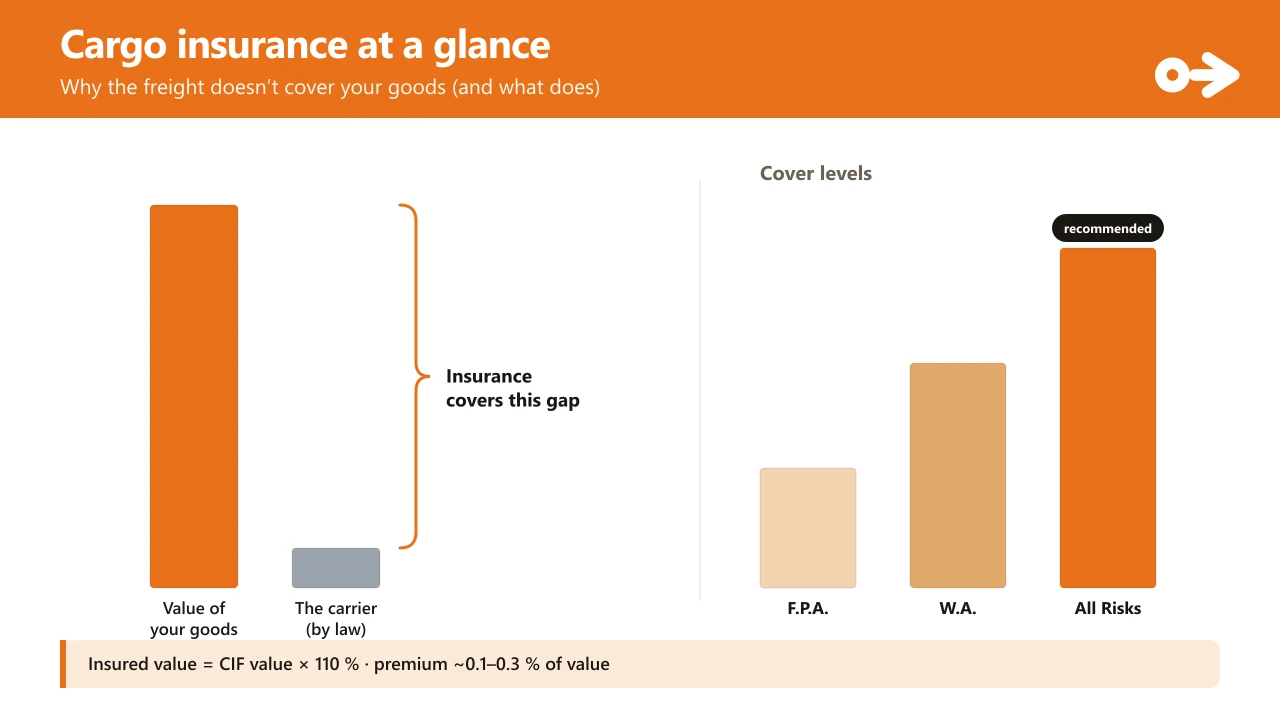
The sea carrier’s liability is capped by law (the international carriage conventions, the Hague-Visby Rules). The limit is roughly:
2 SDR per kilo or 666.67 SDR per package, whichever is greater.
(SDR = Special Drawing Rights, an IMF unit; 1 SDR ≈ USD 1.2-1.3.)
In plain terms: picture a container with USD 20,000 of electronics lost at sea. If that cargo weighs, say, 2,000 kg → the carrier might end up liable for around 4,000 SDR (~USD 5,000)… and that’s the best case, after fighting for it. Often, under the “per package” limit, it’s even less. The freight moves the box; it doesn’t give you back its value.
That gap between what your goods are worth and what the carrier is obliged to pay is exactly what cargo insurance covers.
The shock almost nobody sees coming: general average
This is the argument that convinces even the thriftiest. General average is an ancient principle of maritime law:
If the ship suffers an incident (a fire, a grounding…) and the master sacrifices cargo or incurs costs to save the common venture, ALL cargo owners must contribute to the cost in proportion to the value of their goods — even if your cargo is untouched.
So your container may arrive perfectly, but if there was a fire on board (and on large container ships it happens more than you’d think), you’ll be billed for your proportional share of the losses and salvage. And here’s the harsh part: they won’t release your cargo until you pay or post a bond (which can be a high percentage of the value).
- With insurance: your insurer handles the bond and your contribution. You collect your cargo without drama.
- Without insurance: you have to put up the money (or a guarantee) to rescue your own goods, even if they’re spotless.
For this reason alone, cargo insurance pays for itself.
That’s why cargo insurance exists
Marine cargo insurance covers that gap: it indemnifies you for the real value of your goods if they’re damaged or lost in transit, and it covers general average. It doesn’t replace the freight: it complements it.
The 3 cover levels (and which to choose)
Insurers offer three levels. The names change by country or wording, but the logic is universal:
All Risks (≈ ICC A)
- Covers any damage or loss from external causes in transit
- The broad cover · recommended for general cargo
With Average (W.A. ≈ ICC B)
- Total loss + partial losses from natural events
- Mid-level (heavy weather, lightning, flood…)
F.P.A. (≈ ICC C)
- The most basic: only total loss and major accidents
- Cheap, but leaves out almost all partial damage
Rule of thumb: for general goods, All Risks. The other two save a few cents and leave you exposed exactly where it hurts most (partial damage).
What it does NOT cover (not even “All Risks”)
“All Risks” isn’t “absolutely everything”. Left out:
- Inherent vice or the nature of the goods (they rust, ferment, melt on their own).
- Insufficient packing — if the box wasn’t fit for the voyage, the damage is on you. (Watch this when buying in China.)
- Delay and loss of market (it arrives late and you no longer want it).
- War and strikes: these go separately, as additional cover (War & Strikes). Added only if the route calls for it.
How it’s calculated: insured value and premium
- Insured value = CIF value × 110%. The extra 10% is industry standard: it covers your expected profit and costs, so a total loss leaves you whole rather than at zero.
- Premium: a small percentage of the insured value, typically ~0.1%-0.3% for low-risk general cargo (indicative; depends on goods, route and cover). It’s one of the cheapest things you pay in the whole operation for how much it protects — and it’s part of the real cost of importing.
Two practical details that avoid nasty surprises
- “Warehouse to warehouse” cover, but time-limited. Insurance runs from the moment the goods leave the origin warehouse until they reach yours… but it usually expires ~60 days after discharge from the vessel if you still haven’t collected them. Moral: don’t leave cargo sitting dead at the port.
- If there’s damage, act fast. Apply for a survey immediately, claim against the carrier in writing, and keep every document (policy, B/L, invoice, packing list, survey report). The claim window is usually 2 years.
In short
- The freight doesn’t insure your goods: the carrier’s liability is capped (Hague-Visby: ~2 SDR/kg or 666.67 SDR/package).
- General average can force you to pay even if your cargo is intact → insurance covers that.
- Choose All Risks for general cargo; W.A. and F.P.A. are weaker.
- Mind the exclusions (packing, inherent vice, delay) and war/strikes (separate).
- Insured value = CIF × 110%, premium ~0.1-0.3%: cheap for what it protects.
At EasyChinaShipping we arrange and manage cargo insurance together with your shipment: we tell you the right cover, calculate the insured value and, if something happens, we support you through the claim. See our sea freight from China, or ask us to include insurance in your next quote.