The real cost of importing from China: what landed cost is and how to work it out per unit

When you ask a Chinese factory for a price, the number they give you (the EXW or FOB price) is only the tip of the iceberg. The real cost of your product —the one you must actually use to set prices and work out margins— is what your goods cost once they’re in your warehouse, with everything paid. That’s the landed cost, and getting it right is what separates a professional buyer from someone who improvises. In this guide we show you how to build it piece by piece and, above all, how to allocate it per unit correctly.
What landed cost is (and what it does NOT include)
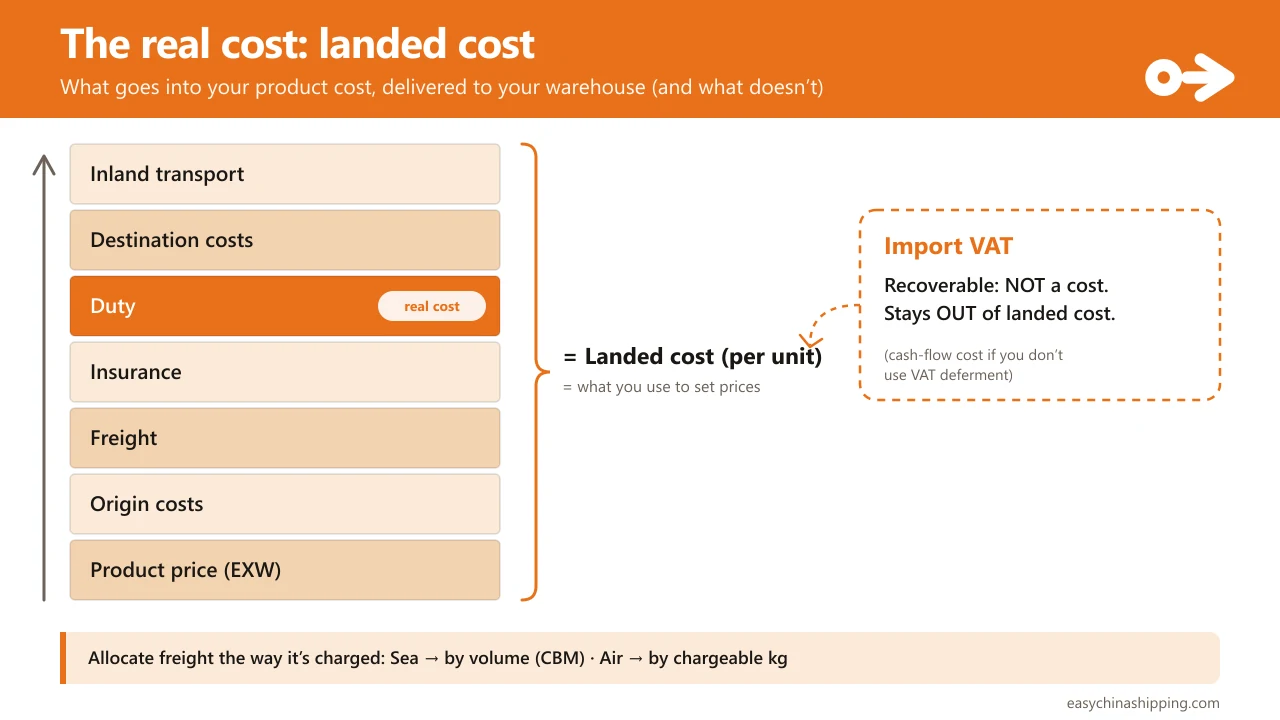
The landed cost is the sum of everything it takes to get a product from the factory to your warehouse, expressed per unit:
Product price + origin costs + freight + insurance + duty + destination costs + inland transport — all divided by the number of units.
What makes the concept powerful is what it deliberately leaves out: import VAT. And here’s the first idea most people get wrong.
The principle that changes everything: real cost ≠ recoverable outlay
Not everything you pay at customs is a cost. You have to separate two things:
- Duty is a real cost. It isn’t recovered. It stays stuck to your goods forever and goes into the landed cost.
- Import VAT is NOT a cost (if you import as a business with the right to deduct). You pay it on entry, but you recover it on your return, just like the VAT on any purchase. It’s a temporary outlay, not a cost. That’s why it stays out of the landed cost.
If you fold VAT into the product cost, your margins will look falsely bad and you’ll set the wrong prices. (We explain the cascade of duty + VAT separately in Import duties and VAT when importing from China.)
The nuance almost nobody accounts for: recoverable VAT does cost (cash flow)
VAT being recoverable doesn’t mean it’s free. Between the moment you front it at customs and the moment you recover it on your return, weeks or months can pass. That money is tied up: working capital you can’t use for anything else. On large orders, that “forced loan to the tax office” adds up.
The good news: there’s a lever to remove it almost entirely — import VAT deferment. In the UK it’s postponed VAT accounting; several EU countries have equivalent schemes (and in some, like France, it’s now automatic): instead of paying import VAT at customs and waiting to recover it, you account for it and deduct it at the same time on your return → zero outlay. Many importers haven’t switched it on and are financing the tax office needlessly. (In sales-tax systems like the US the recovery mechanics differ; check your case.)
The components, one by one (following the chain)
Landed cost is built by walking the goods from the factory to your warehouse. The Incoterm you agree with the supplier decides where your responsibility begins (and which costs are already baked into their price), so the first step is always to normalise everything to the same starting point.
- Product price. The supplier’s invoice. Careful: if it’s EXW, that’s only the price “at the factory door” and everything else is on you from there.
- Origin costs (the great forgotten ones of EXW). Pickup at the factory, Chinese export clearance, origin terminal handling (THC), documentation. With EXW you swallow these and they were not in the price you compared.
- International freight. Sea or air. This is the line you must allocate properly per unit (next section).
- Cargo insurance. A small percentage of value; cheap for what it covers.
- Duty. A real cost. Calculated on the customs value, which in the EU and most of the world is the CIF value (product + freight + insurance) → your transport also pays duty. (The US is the exception: it uses the FOB value, goods only.)
- Destination costs. Terminal handling (destination THC), deconsolidation if it came as groupage (LCL), the customs broker’s fee and, in some countries, local charges (in the US, for example, the MPF and the HMF).
- Inland transport to your warehouse.
All of that, summed and divided by the number of units, is your landed cost per unit. VAT stays apart.
The heart of the calculation: how to allocate freight per unit
Here’s the most common —and most expensive— mistake: allocating freight as a percentage of each product’s value. It’s wrong, because transport isn’t charged on value: it’s charged on what your cargo takes up or weighs. Allocating by value inflates the cost of expensive products and artificially cheapens bulky cheap ones → wrong per-SKU costs in any mixed shipment.
An important note: this per-unit allocation is yours to do, not your freight forwarder’s. It depends on your goods, your business and your industry —you hold the packing list and know what each SKU is—. A good forwarder’s job is to give you reliable data (the actual freight, the duties, the warnings) and teach you the method; the final per-unit maths is yours. That said, here’s how to do it right: allocate using the same unit the carrier charges you by.
If it travels by sea
Sea freight is charged on the W/M rule (“weight or measure”): whichever is greater, volume (m³/CBM) or weight. Since the vast majority of consumer cargo “pays by volume”, the right approach is to allocate freight by the cubic metres each unit takes up, which you get from the packing list (it lists the dimensions of each carton).
- LCL (groupage): you pay for your volume → split the freight across units in proportion to their CBM.
- FCL (full container): you pay for the whole container → the per-unit cost depends on how full it goes. From about 13-15 m³ it usually pays to jump from LCL to FCL; below that, groupage spreads the cost better. (We cover this in FCL vs LCL: full container or groupage.)
If it travels by air
Air freight is charged on chargeable weight = the greater of actual weight and volumetric weight (Length × Width × Height in cm ÷ 6000). Here the logical approach is to allocate freight by each unit’s chargeable kilos.
The key question before you allocate: is your product “weight-driven” or “volume-driven”? A small, dense metal part pays by weight; a light, bulky cushion cover pays by volume. Allocate on the wrong basis and your per-unit cost is off.
Sea · LCL (groupage)
- Charged by volume or weight, whichever is greater (almost always volume)
- Allocate by each unit's m³ (CBM), from the packing list
Sea · FCL (full)
- Charged for the whole container
- Allocate: container cost ÷ units; improves the fuller it goes
Air
- Charged by chargeable weight = max(actual, volumetric)
- Allocate by each unit's chargeable kilos
Example (mixed sea shipment). You put 1,000 bulky, cheap lamps and 1,000 small, expensive tools in the same container. If you allocate freight by value, you load almost all the transport onto the tools (expensive but tiny) and give the lamps a free ride (they eat the container). Allocating by CBM, each lamp carries its real share of freight —which is what actually makes the operation expensive— and you discover that your “cheap” product had a worse margin than you thought.
The costs almost everyone forgets (and that throw the figure off)
An experienced buyer sets aside a provision for these, because they’re the ones that turn a good margin into a loss:
- Demurrage and detention. Charges for holding the container at the port (demurrage) or off-port without returning it (detention). They’re unpredictable and spike with any customs delay. The number-one hole in “closed” landed costs.
- Moulds and tooling (assists). If you pay the factory for a mould or die separately, its value legally must be added to the customs value of the goods it produces. Almost nobody declares it → hidden cost (and risk).
- Anti-dumping and countervailing duties (AD/CVD). Extra duties that can exceed 100% of value, applied to specific Chinese-origin products (steel, aluminium, tyres, ceramics, fasteners, solar panels…). They depend on the code and the manufacturer. Always check whether your product carries them: a single mistake here wrecks the import.
- Quality inspection, defect rate and shrinkage. A 3% defect rate is a real cost per good unit.
- Exchange rate and payment terms. Buying in USD or CNY and the payment terms (deposits) have a financing cost.
- Thresholds that change. De minimis limits and special tariffs move. For example, the US removed the $800 de minimis in 2025 for Chinese-origin shipments: splitting orders to slip under it no longer works. Always confirm the rates in force for your product and destination at the time you import.
The formula, in one line
Landed cost per unit = ( product price + origin costs + freight allocated per unit + insurance + duty + destination costs + inland transport ) ÷ number of units
Import VAT stays apart (it’s recoverable; remember the cash-flow cost if you don’t have VAT deferment).
In short
- Landed cost is the real cost of your product delivered to your warehouse, per unit. It’s the figure you set prices from, not the factory price.
- Duty = real cost (in); VAT = recoverable outlay (out, but with a cash-flow cost that deferment removes).
- Duty is calculated on the CIF value (freight and insurance included) almost everywhere; the US uses FOB.
- Allocate freight the way it’s charged: by CBM (sea) or by chargeable kg (air), never as a percentage of value.
- Set aside a provision for the forgotten costs: demurrage/detention, assists (moulds), AD/CVD, defects and exchange rate.
At EasyChinaShipping we don’t work out your business margin for you —that’s yours— but we give you the reliable pieces so your landed cost comes out right: the actual freight, the duty calculation, customs clearance and warnings about surprises like anti-dumping before you ship. And we teach you how to build it, as in this guide. See our sea freight from China and our customs clearance, or tell us about your case.