Import duties and VAT when importing from China: how they work (general guide)

One of the first questions anyone importing from China asks is: “how much tax will I pay when the goods arrive?”. The good news is that the mechanics are almost the same everywhere: you pay a duty and a consumption tax (VAT across the EU and much of Latin America; VAT, GST or sales tax elsewhere), and they are calculated in a cascade. What changes from one country to another is not how it works, but the rate. This general guide covers the part that applies to any destination.
The two taxes you pay at (almost) any customs
When importing goods, the import clearance normally settles two different things:
- The duty (customs duties): a tax for bringing the goods into a customs territory.
- The consumption tax: the same kind of tax you pay on any purchase in that country, applied to the incoming goods. It is called VAT in the UK, EU and much of Latin America (IVA in Spanish-speaking countries), GST in others, or sales tax (state-level) in the US.
They are calculated in a cascade: the duty first, and the consumption tax on the result. That logic is universal; we’ll see it with numbers below.
The code is global: the Harmonized System
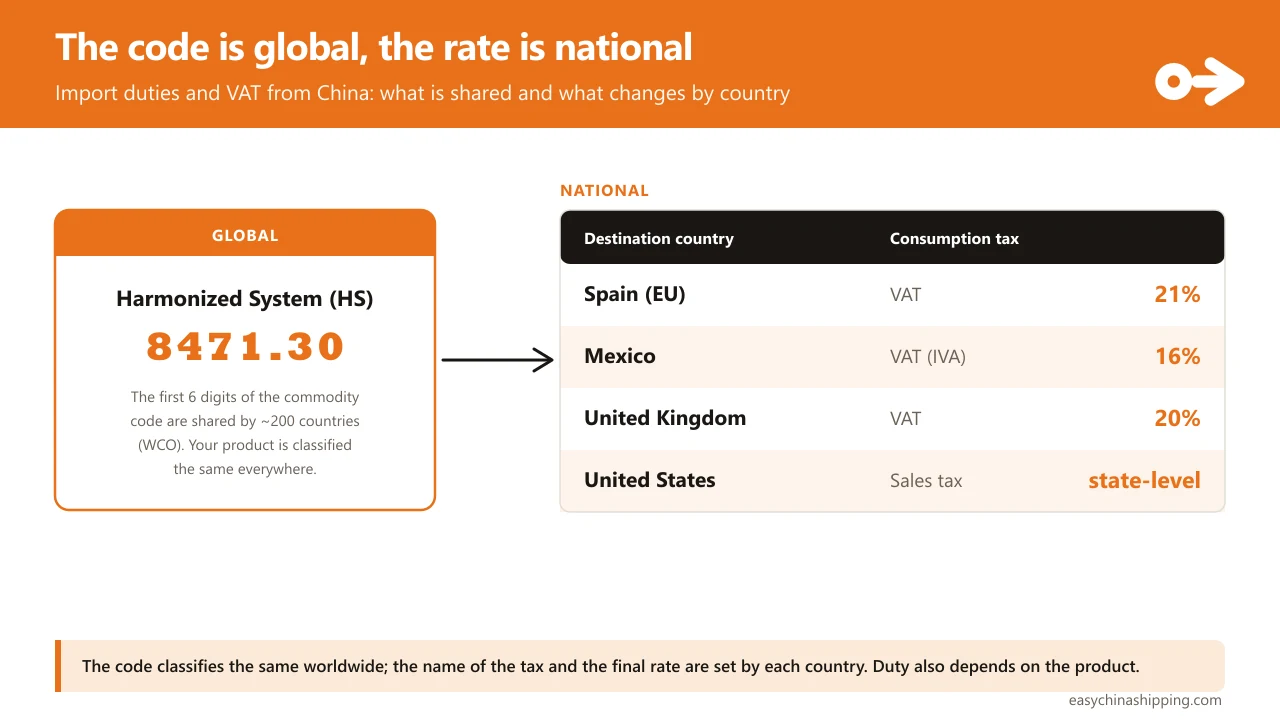
This is the part that does not change from one country to another. Every good has a commodity code, and its first 6 digits are shared by around 200 countries: the Harmonized System (HS), run by the World Customs Organization (WCO). The same product is classified the same way wherever you import it.
Each country (or bloc) extends that code with extra digits for its own tariff: in the European Union it is the TARIC (10 digits). But the common root means classifying correctly is a portable skill: the work of identifying your product is valid for any destination.
Why it matters: the duty rate depends on that code. A wrong code makes you overpay or exposes you to a penalty. It is the piece most worth getting right (and where we can help you most).
The rate is national
What does change by destination country:
- The duty depends on what the product is (its code) and where it comes from. With China, most countries have no preferential trade agreement, so the general (third-country) duty applies. The exact rate is set by each country’s tariff for that code.
- The consumption tax is set by each country: for example, VAT of 21% in Spain, 16% in Mexico, VAT of 20% in the UK; the US has no federal VAT but state-level sales tax. Even within the EU the standard rate varies (from 19% to 27% depending on the country).
So to know your exact figure you need two numbers from your country: the duty rate for your code and the consumption-tax rate.
It is calculated in a cascade (this is universal)
Whatever the country, the order is the same:
- The duty is calculated on the customs value, which is usually the CIF value: the price of the goods + freight + insurance up to the border. In other words, transport and insurance are part of the base.
- The consumption tax is calculated afterwards, on customs value + duty (+ other costs up to the first destination). You pay consumption tax on the duty too.
An example with a 3% duty rate and a 21% consumption tax, starting from a CIF of 10,000:
| Item | Calculation | Amount |
|---|---|---|
| Customs value (CIF) | goods + freight + insurance | 10,000 |
| Duty (example 3%) | 3% of 10,000 | 300 |
| Consumption-tax base | 10,000 + 300 | 10,300 |
| Consumption tax (e.g. 21%) | 21% of 10,300 | 2,163 |
| Total to settle at customs | 300 + 2,163 | 2,463 |
Swap the two rates for those of your country and product, and you have your figure. What does not change is the method.
The reassuring detail: consumption tax is usually recovered; the duty is not
In VAT systems (the EU, much of Latin America and many more), if you import as a business:
- The import VAT you pay at customs is usually deductible: you recover it in your periodic return, just like on any other purchase. It is not a cost, but a temporary outlay (you advance the money and then offset it).
- The duty, on the other hand, is a real cost: it is not recovered. It becomes part of the cost of your goods.
That is why, when working out your margin, the one that really “weighs” is the duty; the consumption tax is mostly a matter of cash flow. (In sales tax systems like the US, the recovery mechanics differ; it’s worth checking your case.)
In summary
- You pay two taxes: duty (per the code, no preference for China in most countries) and a consumption tax (VAT/GST/sales tax).
- The code is global (Harmonized System, WCO); the rate is national.
- They are calculated in a cascade: duty on the CIF, and consumption tax on CIF + duty.
- In VAT systems, the business recovers the consumption tax; the duty is a real cost.
- Classifying the product correctly is what saves you the most (or costs you the most).
And in your specific country?
The final numbers depend on your destination. If you import to Spain, we have the step-by-step detail —with the 21% VAT, the TARIC and a worked example— in Import duties and VAT when importing from China to Spain. Importing to another country? Tell us and we’ll give you the rates that apply to you.
At EasyChinaShipping we handle customs clearance: we help you with the classification of the code, calculate the taxes in advance and coordinate clearance so there are no surprises on arrival. See how our customs clearance from China works, and if you don’t have it yet, start with what the EORI is and how to apply for it.