Import duties and VAT from China to Spain: how to calculate (with example)
One of the first questions anyone importing from China asks is: “how much tax will I pay when the goods arrive in Spain?”. The answer has two parts —the duty and the import VAT— and once you understand them, they stop being scary. In this guide we explain what they are, what they are charged on, and we walk through it with a worked example.
This guide is specific to Spain. If you also import to other countries, the underlying mechanics are the same: you’ll find them in the general guide to import duties and VAT from China.
The two taxes you pay at customs
When importing goods from China to Spain, the import clearance settles two different things:
- The duty (customs duties): a tax on the entry of the goods into the European Union.
- Import VAT: the same VAT you pay on any purchase, but applied to the goods coming in.
They are calculated in a cascade (the duty first, and VAT on the result), so it helps to take them in order.
The duty: how much and on what
The duty depends on two things: what the product is and where it comes from.
- What the product is → determined by its commodity code (TARIC). Every good has a code, and each code has a rate. Some products carry 0% duty and others higher rates; that is why classifying correctly is key (see below).
- Where it comes from → with China there is no preferential trade agreement, so the general (third-country) duty applies (the same as for any country without special treatment). Do not expect origin-based reductions like those countries with an agreement enjoy.
The duty is calculated on the customs value, which is normally the CIF value: the price of the goods plus freight and insurance up to the EU border. In other words, transport and insurance are also part of the base the duty is calculated on.
Import VAT: 21% on what base
In Spain, the standard VAT is 21% (some products have reduced rates of 10% or 4%). But mind the base: import VAT is not calculated only on the value of the goods, but on:
VAT base = customs value (CIF) + duty + other costs up to the first destination
That is, VAT is applied after adding the duty. That is why it is a cascade: you also pay VAT on the duty.
Worked example, step by step
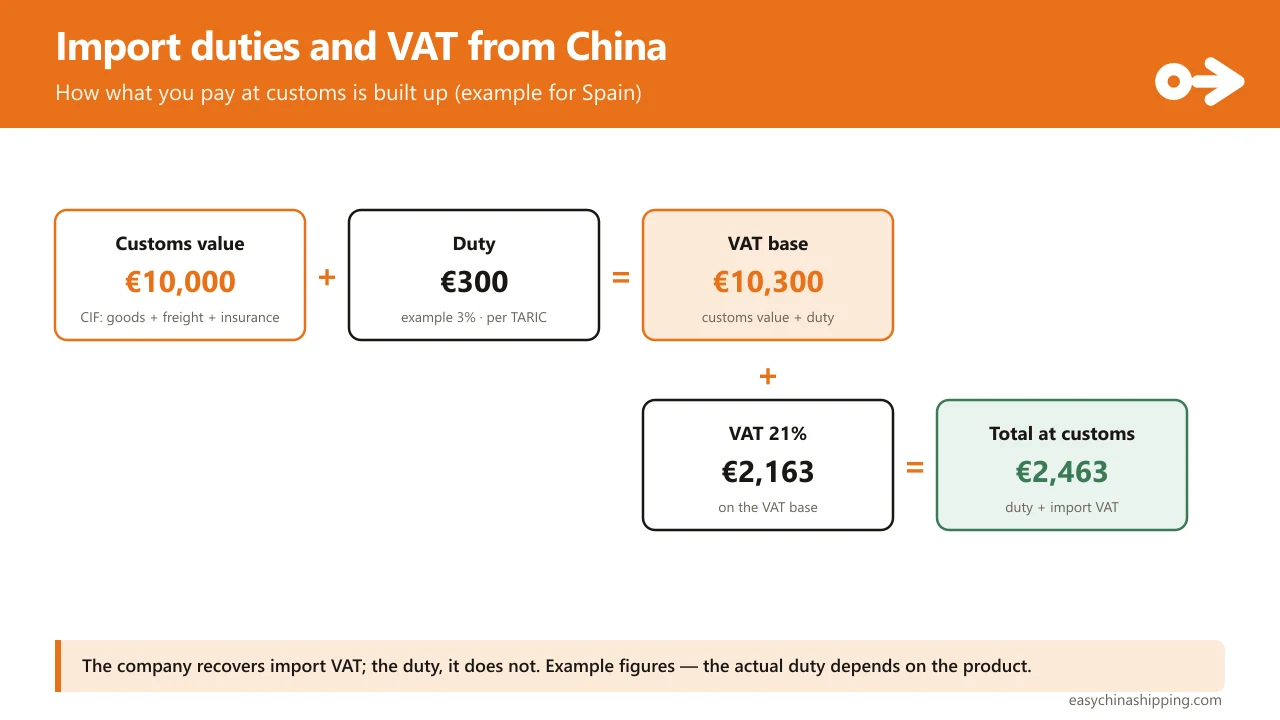
Let’s assume an import with a customs value (CIF) of €10,000 and an example duty of 3% (the real one will depend on your product):
| Item | Calculation | Amount |
|---|---|---|
| Customs value (CIF) | goods + freight + insurance | €10,000 |
| Duty (example 3%) | 3% of €10,000 | €300 |
| VAT base | €10,000 + €300 | €10,300 |
| Import VAT (21%) | 21% of €10,300 | €2,163 |
| Total to settle at customs | €300 + €2,163 | €2,463 |
Swap the duty rate for the one on your goods and you have your figure. What matters is the method: the duty first on the CIF, then VAT on the sum.
Thresholds: the €150 mark and the end of the €22 exemption
Two thresholds worth keeping clear:
- Duty: shipments with an intrinsic value of €150 or less are exempt from duty (but not from VAT).
- VAT: since 1 July 2021, the EU removed the old VAT exemption for low-value consignments (those under €22). Today VAT is paid from the very first euro. For sales to end consumers up to €150 there is the IOSS system, which simplifies its handling.
The moral: do not count on “slipping through” commercial goods without VAT because they are low value. That loophole no longer exists.
The detail almost nobody tells you: VAT is recovered, the duty is not
Here is the difference that reassures anyone importing as a business the most:
- The import VAT you pay at customs is deductible: you recover it in your periodic VAT return (form 303), just like the VAT on any other purchase. For your business it is not a cost, but a temporary outlay (you advance the money and then offset it).
- The duty, on the other hand, is a real cost: it is not recovered. It becomes part of the cost of your goods.
That is why, when working out your margin, the one that really “weighs” as a cost is the duty; VAT is mostly a matter of cash flow (having the money to advance it). If you import as a private individual, careful: with no economic activity you cannot deduct that VAT.
Common mistakes
- Confusing duty with VAT. They are two different taxes, with different bases and different treatment (one is recovered, the other is not).
- Misclassifying the product (TARIC). A wrong code makes you overpay or exposes you to a penalty. It is the piece most worth getting right.
- Forgetting that freight and insurance are in the base. The customs value is CIF, not just the price of the goods.
- Counting on exemptions that no longer exist. The €22 VAT one disappeared in 2021.
In summary
- You pay two taxes at customs: duty (per TARIC, no preference for China) and import VAT (21%).
- They are calculated in a cascade: the duty on the CIF value, and VAT on CIF + duty.
- The business recovers the VAT; the duty is a real cost.
- Correct tariff classification is what saves you the most (or costs you the most).
At EasyChinaShipping we handle customs clearance: we help you with TARIC classification, calculate the taxes in advance and coordinate clearance so there are no surprises on arrival. See how our customs clearance from China works, review what you need to import from China to Spain, and if you don’t have it yet, start with what the EORI is and how to apply for it. Questions about your case? Tell us and we’ll give you the clear numbers.