The 10 most common mistakes when importing from China (and how to avoid them)
Importing from China pays off, but almost every nasty surprise comes from the same handful of places. The good news: these are known, avoidable mistakes. Anyone who has spent years at the origin —where the goods are made and loaded— has seen them again and again. Here are the 10 most common mistakes when importing from China and, above all, how to steer clear of them.
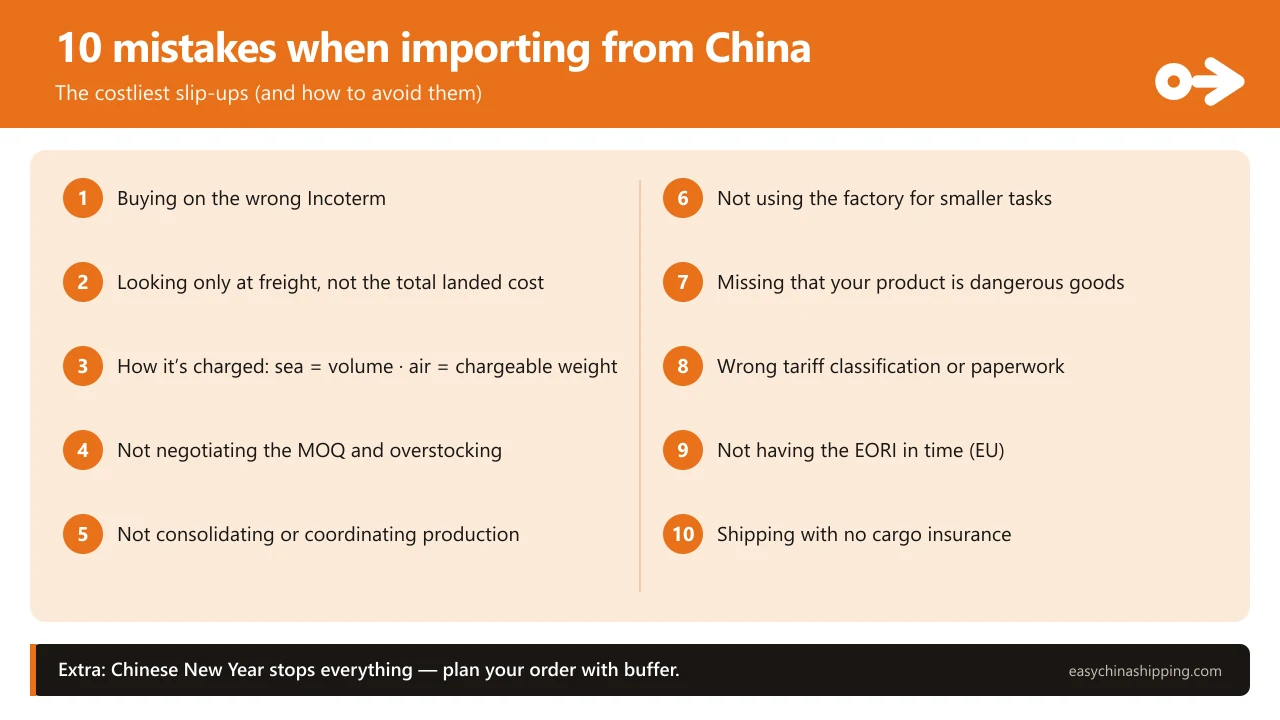
1. Buying on the wrong Incoterm
The Incoterm defines who pays what and who bears the risk at each leg. Closing the deal on the wrong term is the costliest mistake there is. Buying EXW without realising it means you must arrange transport from the factory door in China; assuming a CIF price “reaches your warehouse” is another classic (it only reaches the destination port). And beware the supplier who offers DDP “all included”: if their agent gets stuck at customs in your country, you’re the one left waiting. Choose the Incoterm deliberately; for most importers, FOB is a good balance. If you’d rather we handle the last mile, see door-to-door shipping from China.
2. Looking only at the freight, not the total landed cost
The freight rate is only one part. The real cost at your warehouse (the landed cost) includes factory pickup, origin charges, export clearance, freight, import clearance, duties and VAT, and last-mile delivery. Many compare quotes on freight alone and get a surprise on arrival. Always ask for the full breakdown and spread that cost properly across the final unit price of your product — that’s what really drives your margin. We explain the customs side in customs clearance from China.
3. Not understanding how freight is charged (volume vs weight)
This one separates the beginner from the pro. In sea freight, volume rules: you’re billed mostly by cubic metres (CBM), and weight matters less. In air freight, chargeable weight rules: the greater of actual weight and volumetric weight (how much space your cargo “takes”). Getting this right changes real decisions: how to pack, whether sea or air suits you, and whether to go full container or groupage (we cover it in FCL vs LCL). Bulky, light packaging can blow up your air cost without you noticing.
4. Not negotiating the MOQ and overstocking
The supplier will quote a minimum order quantity (MOQ), but it’s almost always negotiable, especially on a first trial order. Accepting it blindly leads to buying too much “just to hit the minimum”: you tie up cash and fill the container with product that then won’t sell. Negotiate the MOQ and match the quantity to what you’ll actually sell; you can scale up once the product works.
5. Not consolidating across suppliers or coordinating production
If you buy from several suppliers, the mistake is letting each ship on its own: duplicated freight and chaos. The efficient move is to coordinate production timing so everything is ready at once and consolidate into a single shipment. A good agent at origin orchestrates this for you: they group cargo from your different suppliers and optimise the sea freight.
6. Not using the factory for the smaller tasks
Chinese factories do cheaply a lot of jobs that would cost a fortune elsewhere: consolidation, small local transport to the port or the agent’s warehouse, simple relabelling, basic quantity checks… Ignoring this leaves money on the table. Use the origin’s labour for the small stuff and save international transport for what really has to cross half the world.
7. Not spotting that your product is dangerous goods
Many everyday products are dangerous goods (DG) without the importer knowing: lithium batteries, power banks, inks, paints, aerosols, some cosmetics. A typical example: an ink that turns out to be UN1210, Class 3 (flammable). Mis-declaring it (or not declaring it) can end in a rejected shipment, fines or seizure. If your cargo could fall here, it must be packed, documented and shipped to spec: we explain what can be sent and how in dangerous goods from China.
8. Wrong tariff classification or paperwork
Two guaranteed sources of a hold. The tariff classification (HS/TARIC code) sets the duty: get it wrong and you overpay or expose yourself to a penalty. And the documents (commercial invoice, packing list, bill of lading) must agree with each other and describe the goods accurately; a vague description or figures that don’t match is an invitation for customs to stop your container. We help with classification and coordinate clearance in customs.
9. Not having the EORI in time (EU)
To import into the European Union you need an EORI number, and you’d better have it before the goods arrive, not discover it with the container at the port. It’s a simple formality, but forgotten it halts clearance and racks up storage charges. We explain it step by step in what the EORI is and how to apply.
10. Shipping with no cargo insurance (the mistake that can ruin a shipment)
Time to bust a myth: the carrier does not cover the value of your goods. Its liability is capped by law at a very low figure (on the order of 2 SDR/kg, a few euros per kilo), and on top of that it’s fault-based and full of exclusions. For real value, it’s worthless.
Cargo insurance is voluntary (unless the Incoterm imposes it, as CIF does), and skipping it is a gamble. And we’re not talking about freak events: containers lost overboard, water getting inside the container and ruining the goods without the container even falling, theft, handling damage… it happens. Cargo insurance is arranged through the Institute Cargo Clauses: ICC(A) (“all risks”) is the one to go for; ICC(C) is the bare minimum. It’s insured on CIF + 10% and the premium is around 0.1%–0.6% of value: pennies against what it protects.
And there’s a detail almost nobody knows: General Average. If the vessel suffers a serious incident (a fire, a grounding) and expenses or cargo sacrifices are needed to save the voyage, every cargo owner contributes pro rata, even if your goods are untouched. With no insurance, the carrier can demand a cash bond to release your container. With insurance, your insurer covers it. That’s why, except for very low values, insuring is the sensible call.
Extra: don’t underestimate the timing (Chinese New Year)
China stops for Chinese New Year (late January or February, depending on the year): factories close for a week or two and the ramp-up afterwards is slow. Add the Golden Week in October and the pre-Christmas peak season, and mis-planning the calendar means running out of stock right when you sell the most. Bring production and booking forward with a buffer.
Almost all of these mistakes share one thing: they’re avoided by having someone at the origin who knows the ground. At EasyChinaShipping we’re a Chinese freight forwarder operating from where your goods are made and loaded; we coordinate suppliers, transport, customs and insurance end to end —and if you sell on marketplaces, shipping to Amazon FBA too. Tell us about your shipment and we’ll make it easy, in writing and with no surprises.