How to ship your goods from China to Amazon FBA (step-by-step guide)
Selling on Amazon with FBA is convenient: you send the stock and Amazon stores, picks, packs and ships your orders. But between your factory in China and the Amazon fulfilment centre there’s a journey with strict rules: a mislabelled box or a non-compliant pallet can sit stuck at receiving for weeks. In this guide we explain, step by step, how to ship your goods from China to Amazon FBA without nasty surprises.
What Amazon FBA is (and why shipping from China has a catch)
FBA (Fulfilled by Amazon) means you keep your inventory in Amazon’s fulfilment centres and Amazon is the one that stores, packs and ships it to your customers. In return, your goods have to enter their system following their rules to the letter.
The catch when you do it from China is that you combine two worlds: international logistics (transport, customs, long lead times) and Amazon’s prep requirements (labels, weights, packaging). If you only master one of the two, the other tends to break. That’s why it pays to understand the whole chain before you launch your first shipment.
What Amazon requires of your shipment
Amazon won’t accept just any box that turns up at its door. These are the requirements that cause the most trouble when importing from China.
Three labelling levels
Your goods are labelled in three layers, and all three have to be right:
- Unit — each product carries its FNSKU code (the identifier Amazon assigns to your item). It’s what they scan to know the unit is yours.
- Master carton — each shipping box carries its shipment and content label, so receiving knows what’s inside without opening it.
- Pallet — if palletised, the pallet carries its Amazon label and the carrier’s.
If one of the three layers fails, receiving slows down or rejects the shipment. That’s why labelling is best done at origin, before the goods leave China: fixing a label once the cargo is at destination is slow and expensive.
The carton weight cap
Amazon limits each box to a maximum of around 23 kg (boxes over ~15 kg must also carry a “heavy package” label). A practical tip: ask your factory to stay under ~22 kg per box, leaving scale margin. Factories tend to “round up” when filling boxes, and a couple of cartons over the limit can hold up the whole shipment at receiving.
Your stock’s route, step by step
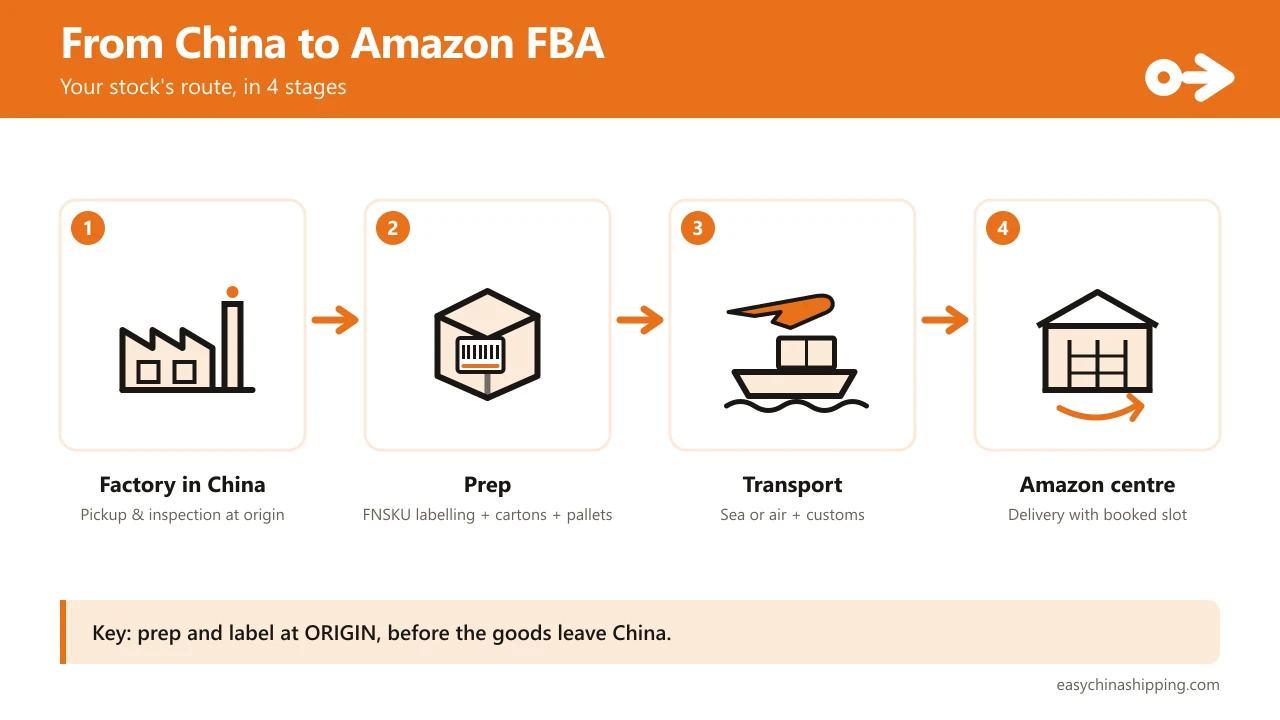
Beyond the details, your goods always follow the same four stages:
- Pickup and prep in China. Collected at the factory, inspected (condition and quantity), repacked if needed and labelled to Amazon’s spec (FNSKU + cartons + pallets).
- Export clearance and transport. It leaves China with its paperwork and travels in the chosen mode —sea or air— with tracking.
- Import at destination. Import clearance is done in the arrival country (watch out for this, see below).
- Delivery to the Amazon fulfilment centre, with a booked appointment if the centre requires one.
Knowing these helps you understand where a shipment can get stuck and who to ask at each stage.
Customs: careful, Amazon is not your importer
This is the mistake that costs first-timers the most: Amazon does not act as the importer of your goods. You can’t name Amazon as the customs consignee and forget about it. You need your own importer of record in the destination country —for example, an EORI number if you import into the European Union— and proper import clearance before the cargo reaches the fulfilment centre.
If you don’t have your EORI yet, we explain how it works here: What EORI is and how to apply for it.
Sea or air to restock
The eternal question: by ship or by plane? For FBA, the answer depends on your stock buffer:
- Sea freight is the cheapest and the default for restocking with foresight. In return it takes weeks, so you have to order well ahead.
- Air freight is considerably more expensive, but it saves you when you’re low on inventory and can’t afford a stockout (running out on Amazon hurts your ranking).
A common strategy is to combine both: the bulk by sea and an urgent top-up by air if sales spike before the ship arrives.
Direct to Amazon or through an intermediate warehouse (3PL)
This is the decision almost nobody explains, and it makes a real difference when you import a full container. Amazon may split your shipment across several centres at once, which complicates a direct delivery from the port. You have two paths:
Direct to Amazon
- Cheaper: one delivery fewer
- Less handling of the cargo
- Inflexible: Amazon decides which centres
- One label error can block the whole shipment
- You pay Amazon storage from day one
Intermediate warehouse (3PL)
- The 3PL receives the full container
- Checks quality and relabels if something fails
- Sends staggered replenishments to FBA
- Cuts your storage cost at Amazon
- Avoids many rejections at receiving
Quick rule: for small volumes or first shipments, direct to Amazon usually does the job. When you move containers and want quality control and flexible restocking, the intermediate warehouse (3PL) almost always pays off.
Common mistakes that block your goods
The most common slip-ups when shipping from China to FBA are nearly always the same:
- FNSKU labels misplaced, unreadable or missing. Receiving can’t identify your product.
- Cartons over the weight limit, without the “heavy package” label.
- Not having your importer of record ready (no EORI or equivalent) when the cargo is already on its way.
- Trusting the factory’s packaging without checking it: soft or poorly sealed boxes that arrive crushed.
- Cutting it fine on lead times and running out of stock waiting for the ship, instead of planning the restock.
Almost all of them are avoided by one thing: preparing and checking everything at origin, before the goods leave China.
How we do it
At EasyChinaShipping we operate from origin: we collect at your Chinese factory, inspect, label to Amazon’s spec (FNSKU and the three levels), choose sea or air with you, coordinate import clearance with your importer of record, and deliver to the fulfilment centre. If it suits you, we also set up the step through an intermediate warehouse to restock sensibly.
You can see the full service in Shipping from China to Amazon FBA, or just tell us about your case.
Restocking on Amazon from China? Tell us your product and which marketplace you ship to and we’ll give you a clear door-to-fulfilment-centre quote, prep included.
Amazon and Amazon FBA are trademarks of Amazon.com, Inc. or its affiliates. EasyChinaShipping is an independent logistics provider with no official relationship with Amazon.