Can I import from China without the “Made in China” label? Private label yes, origin fraud no
It is one of the questions we are asked most often: “can I sell what I import from China under my brand, without it saying Made in China?”. There is rarely bad faith behind it, just a reasonable commercial concern: end customers sometimes associate “Made in China” with low quality, even when the product is excellent. The answer has nuances worth knowing well, because on this subject the line between a legal practice and fraud is very thin.
The direct answer: yes, in many cases you can sell your Chinese goods under your own brand, with no visible “Made in China” on the product. In the European Union and the United Kingdom there is, as a general rule, no obligation to mark the country of origin on consumer products. In the United States, Mexico and Brazil, however, the origin is mandatory on the product or its label. And in every country, without exception, one rule never changes: on customs documents the origin must be the real one. Putting another country is not marketing: it is fraud.
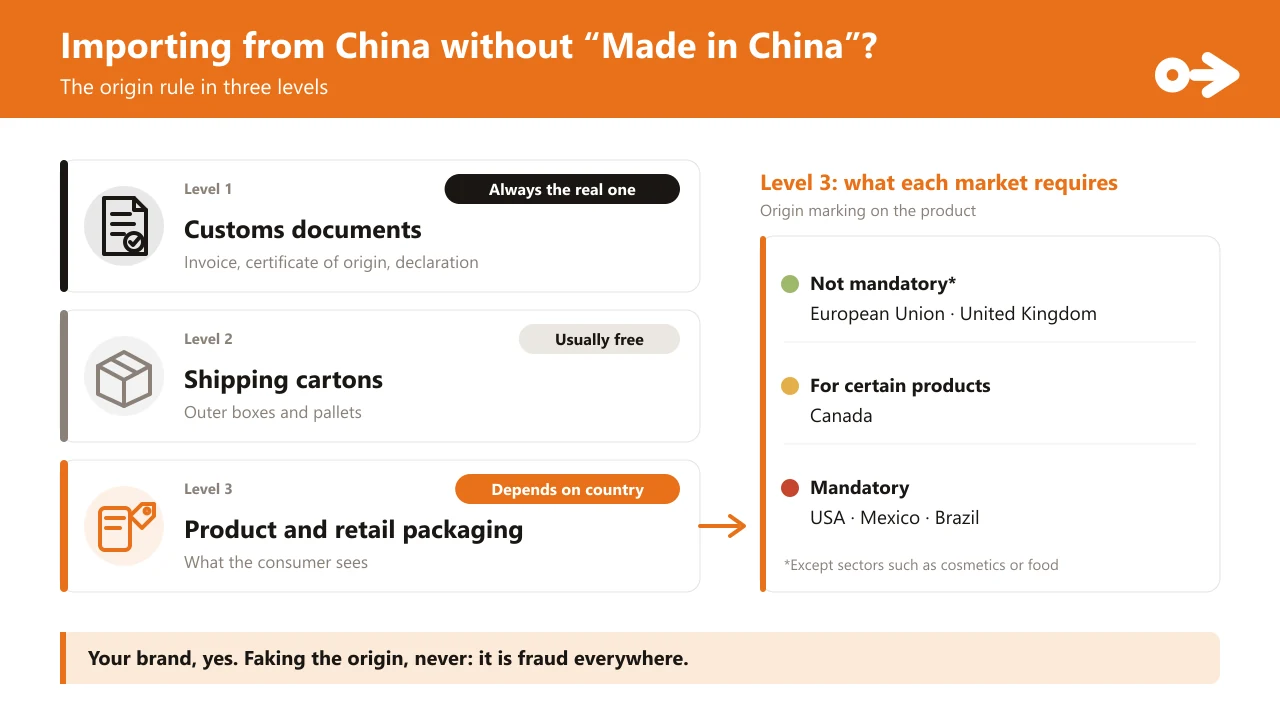
The universal rule: origin in three levels
The clearest way to understand it is to separate where the origin appears. What you declare at customs is not the same as what you print on the carton or on the label your customer sees.
Level 1 · Customs documents: always the real origin
The commercial invoice, the certificate of origin and the customs declaration must reflect the country where the goods were actually made. There are no nuances or differences between countries here: the origin determines the duty you pay, whether anti-dumping duties apply and whether you are entitled to any tariff preference. Declaring another origin is customs fraud anywhere in the world. (If you want to review which papers travel with your goods, we explain it in the documents needed to import from China.)
Level 2 · Shipping cartons: usually free
Outer cartons and pallets —the packaging only the carrier and your warehouse see— are almost never required to carry an origin marking aimed at the consumer. It is common to ask the supplier for plain cartons, without their logo or text in Chinese. The important exception is in the United States: if a specific article is exempt from marking, it is its container that must show the origin.
Level 3 · Product and retail packaging: depends on the country
This is what your customer sees, and this is where each market has its own rule. It is the level that decides whether you can sell without a visible “Made in China”.
What each market requires
Not mandatory (with exceptions)
- European Union (Spain, France, Portugal, Germany, Italy, Belgium…): no general obligation to mark the origin
- United Kingdom: same approach
- But: imported cosmetics must state the country of origin, and there are sector rules (food)
For certain products
- Canada: a list of goods must be marked with their country of origin
- The importer is responsible for them arriving correctly marked
- Separately, consumer labelling usually has to be in English and French
Mandatory on the product
- United States: origin in English, conspicuous, legible and indelible; customs will not release unmarked goods
- Mexico: “Hecho en…” statement in Spanish (NOM-050)
- Brazil: origin in Portuguese (Consumer Defence Code)
European Union and United Kingdom: free, but no misleading
In the EU there is no general obligation to put “Made in” on consumer products. A regulation to make it mandatory was proposed, but it was never adopted, and the new General Product Safety Regulation does not require it either. In practice, this means you can sell your product under your brand without stating the country of origin.
What is prohibited is misleading the buyer. And there are sector exceptions worth knowing:
- Cosmetics: the EU cosmetics regulation requires the country of origin to be stated on imported products.
- Food: has its own origin rules, depending on the product.
- Italy, with particular severity: selling a non-Italian product labelled “Made in Italy” is a criminal offence, and using symbols, flags or trademarks that make people believe it is Italian —even if the real origin appears elsewhere— is punished with fines of €10,000 to €250,000. It is enforced from customs onwards.
United States: mandatory and strict
This is the opposite case. US law requires that every imported article be marked with the English name of its country of origin, in a conspicuous place and as legibly, indelibly and permanently as the nature of the article permits. If it arrives unmarked, customs will not release the goods until it is corrected. So if you sell in the United States, “Made in China” (or “China”) has to be there.
Canada: depends on the product
Canada requires origin marking on a specific list of goods, and it is the importer who is responsible for them arriving correctly marked. On top of that comes consumer labelling, which normally has to be in English and French.
Mexico, Brazil and much of Latin America: mandatory and in the local language
In Mexico, the labelling standard for consumer products requires a statement such as “Hecho en…” or “Producto de…”, in Spanish. In Brazil, the Consumer Defence Code requires information on the product’s origin in Portuguese. Many other countries in the region follow a similar approach: if you sell in Latin America, assume you will have to state the origin in the local language, and confirm it for each destination.
What you can do (and is legal)
- Private label or OEM. Your brand, your design and your packaging, made by a Chinese supplier. It is entirely legal and it is how much of world trade works.
- Discreet, honest marking. Where origin is mandatory or you want to state it, wording such as “Designed in the UK · Made in China” is legal, common and highlights your part of the work.
- Plain cartons. Asking the supplier for cartons without their logo, their brand or text you don’t want.
- Removing the manufacturer’s brand. Having your supplier not put their name on your product is a normal commercial agreement.
What you can never do
- Put another country of origin. Writing “Made in EU”, “Made in Spain” or “Made in Italy” on a product made in China is misleading and, depending on the country, a criminal offence.
- Think that relabelling changes the origin. It does not. In the EU, a product takes the origin of the country where it underwent its last substantial transformation: a process that results in a new product or an important stage of manufacture. Repacking, relabelling or reboxing is never enough.
- Route goods through a third country. Shipping goods to another country, changing the label and re-exporting them to avoid duties or anti-dumping duties is fraud, and it is prosecuted. The European Anti-Fraud Office has investigated cases such as e-bikes built in Türkiye from Chinese parts and sold in Italy as Turkish to avoid the duties that applied to them.
- Suggest a false origin. Flags, national colours or phrases that make people believe the product comes from another country, even if you do not say so explicitly.
In short
- At customs, the origin is always the real one, in every country.
- On shipping cartons, you are usually free.
- On the product, it depends: not mandatory in the EU and the UK (except sectors such as cosmetics), mandatory for certain products in Canada and mandatory in the United States, Mexico and Brazil.
- Private label, yes. Changing the origin by relabelling or routing through a third country, never.
Note: labelling and origin rules vary by country and product and may change. This guide describes the general situation at the time of writing; for your specific case, confirm it with your customs broker or an expert in the destination market.
At EasyChinaShipping we check with you and your supplier what your product needs to carry before it ships, so there are no surprises at customs in the destination country. See our customs clearance from China, review how duties and VAT are calculated or tell us about your shipment.