Incoterms made simple: FOB, EXW, CIF, DDP… which one when importing from China?
When you close an order with a Chinese supplier, sooner or later a code shows up: FOB, EXW, CIF, DDP…. These are the Incoterms, and although they sound like jargon, they decide something very concrete: who pays for each leg of the journey and who bears the risk if something goes wrong. Choosing well saves you money and nasty surprises. Here they are in plain terms.
What an Incoterm is (in one sentence)
An Incoterm (International Commercial Terms) is an international standard rule that defines, in a sale, how far the seller’s responsibility goes and where yours begins: who arranges and pays for transport, who clears customs, and at what point the risk over the goods transfers.
The key point is that the price your supplier quotes depends on the Incoterm. The same “€10,000” order doesn’t mean the same in EXW as in DDP: in one you pay €10,000 at the factory door and everything else is on you; in the other, those €10,000 already include transport and customs to your warehouse.
The four you’ll see most when importing from China
EXW (Ex Works)
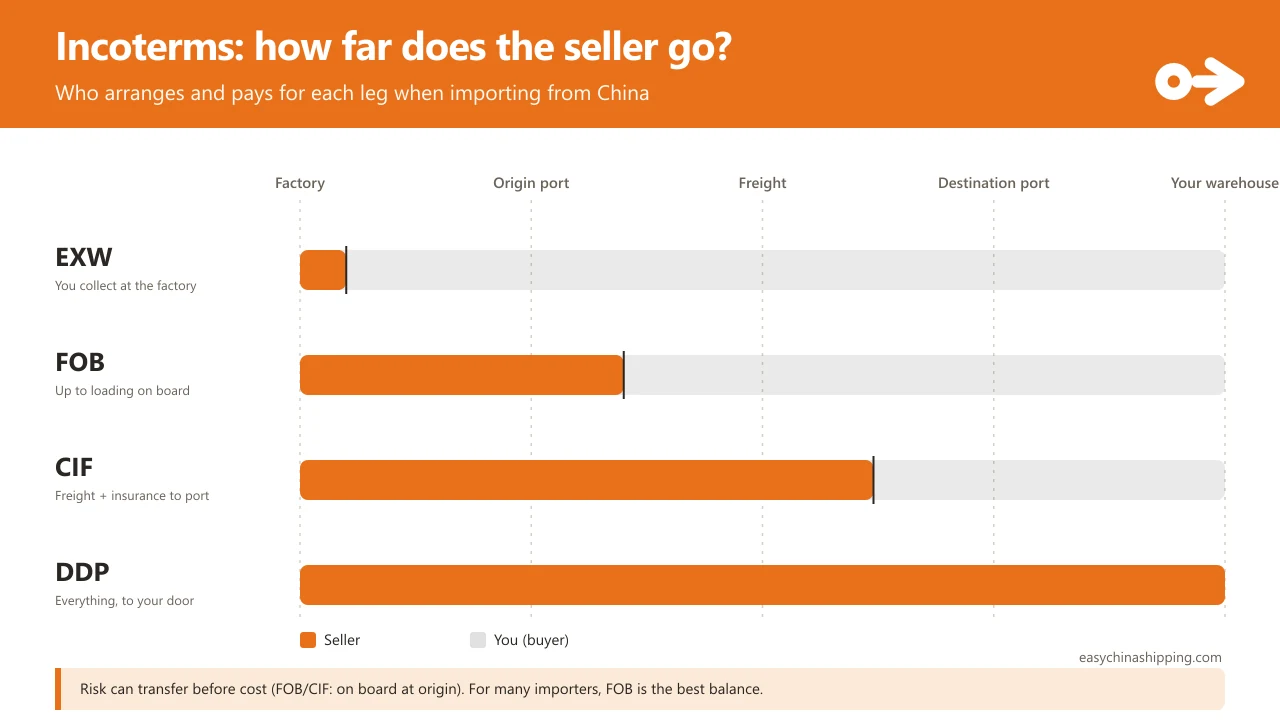
The seller only makes the goods available at their factory. From there, everything is yours: inland transport in China, export clearance, freight, import customs and delivery. It gives full control, but also full responsibility —including Chinese export clearance, which is tricky for a foreigner.
FOB (Free On Board)
The seller takes the goods to the Chinese port and loads them on the vessel, export clearance included. Once on board, the freight, insurance and destination customs are yours. It’s the most common balance point: the supplier handles the Chinese side (which they know), and you control the international freight (where most of the cost sits).
CIF (Cost, Insurance and Freight)
Like FOB, but the seller also pays the freight and basic insurance to the destination port. Watch two traps: (1) it only reaches the destination port, not your warehouse —import customs and last mile are still yours—; and (2) risk transfers before cost (goods travel at your risk from loading at origin, even though the seller pays the freight). Also, the minimum insurance CIF requires is basic.
DDP (Delivered Duty Paid)
The seller handles everything up to your door, including duties and VAT. It sounds convenient, but beware the supplier’s “cheap DDP”: if their agent gets stuck at customs in your country (which they don’t control well), the delay and the extra cost land on you.
Quick table: who does what
| Transport in China | Export clearance China | International freight | Import clearance destination | |
|---|---|---|---|---|
| EXW | You | You | You | You |
| FOB | Seller | Seller | You | You |
| CIF | Seller | Seller | Seller | You |
| DDP | Seller | Seller | Seller | Seller |
Which one suits me?
There’s no universally “best” Incoterm, but there is a practical recommendation for most importers:
- FOB is usually the best balance. The supplier handles the Chinese side (inland transport and export clearance, which they master), and you control the international freight and import clearance with your forwarder —which is where the real price is decided and where you want control—.
- EXW only if you have a very solid agent in China to handle export clearance; otherwise you’re making life hard.
- CIF can work to start, but remember it doesn’t reach your door and the insurance is minimal (better to insure yourself with “all-risk” cover).
- DDP is handy for samples or small orders, but for serious operations it takes away your control over customs in your own country.
Rule of thumb: the further right on the chart (DDP), the less you worry… but the less you control and the more the “landed” cost usually is. FOB keeps you at the wheel for the leg that matters.
Common Incoterm mistakes
- Buying EXW without realising it and finding out you have to arrange even the Chinese export clearance.
- Believing CIF reaches your warehouse. It only reaches the destination port; the rest is yours.
- Trusting the supplier’s “all-included” DDP and getting stuck at destination customs.
- Not looking at the total cost (landed cost). The Incoterm changes what the price includes; always compare the cost delivered to your warehouse, not the supplier’s bare number.
In short
- The Incoterm defines who pays and who bears the risk on each leg, and changes the price of your order.
- The four key ones when importing from China: EXW, FOB, CIF, DDP (from least to most handled by the seller).
- For most, FOB is the best balance: the supplier handles China, you control freight and customs.
At EasyChinaShipping we advise you on which Incoterm suits each operation and handle the international leg and clearance. See our door-to-door shipping from China if you’d rather forget about it all, or how customs clearance works. Still torn between FOB and the rest? Tell us your case and we’ll tell you which works out best.