Can I Defer Import VAT? Which Countries Allow It and How It Works

When goods from China arrive at a European port, customs will not release them until the import VAT is paid. If you are a business entitled to deduct it, that VAT is not a cost: you will get it back later. But until then you have advanced it, and on a mid-value container that means thousands of euros tied up for weeks or months. Hence the question: “can I avoid advancing it?”.
The direct answer: in many countries, yes. It is called deferral or postponed accounting of import VAT: instead of paying it at customs, you declare it on your periodic VAT return and deduct it on that same return, so the effect on your cash is zero. France, the United Kingdom, Ireland, Spain, the Netherlands, Belgium, Portugal and Poland offer it, each with its own conditions. Germany and Italy, by contrast, have no equivalent general-purpose mechanism: at most a payment deferral or solutions for specific cases.
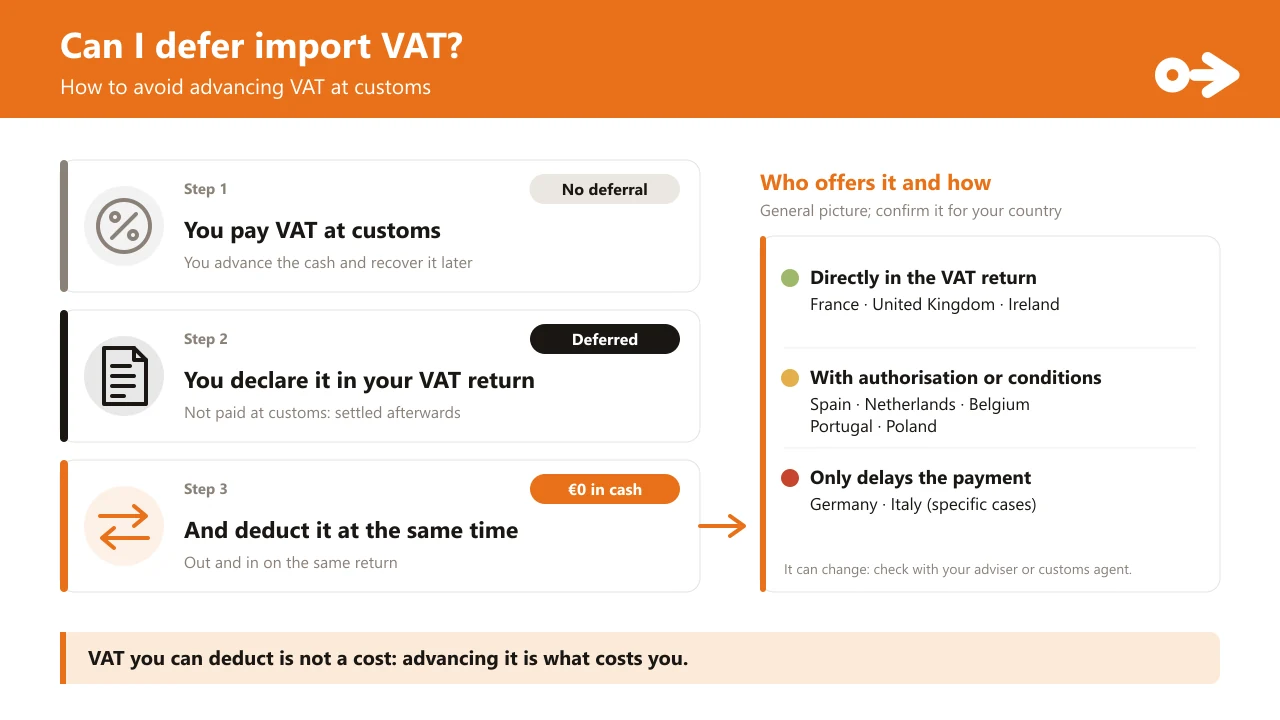
Why it matters: VAT is neutral, but advancing it costs money
If your business can deduct import VAT, the tax is neutral: you pay it at customs and recover it on your next return. What does cost you is the cash advanced: capital you cannot use to pay your supplier, place the next order or fund advertising. The bigger and more frequent your imports, the more it weighs. (Duty, on the other hand, is a cost and goes into your landed cost; we explain it in the real cost of importing and in duties and VAT when importing from China.)
Remember too that VAT is calculated on the customs value plus duty, not just on the invoice, so the amount to advance is often larger than it looks.
How deferral works
The idea is the same in every country that allows it:
- The goods are cleared through customs without paying the import VAT at that moment.
- The customs declaration records the amount, and you report it on your periodic VAT return, as VAT due.
- On that same return you deduct it as input VAT. What goes out and what comes in cancel each other: you put in no cash.
Universal condition: it is for whoever can deduct VAT, that is, a VAT-registered business in the destination country. If you import as a private individual, or your activity does not entitle you to deduct, VAT is a real cost and there is nothing to defer.
What each country offers
Directly in the VAT return
- France: mandatory, automatic self-assessment for businesses with a French VAT number (since 2022)
- United Kingdom: Postponed VAT Accounting (PVA); no prior application, flagged on the customs declaration
- Ireland: Postponed Accounting, with possible exclusions or security required by Revenue
With authorisation or conditions
- Spain: deferred import VAT, by formal election and with monthly returns
- Netherlands: Article 23 licence; a non-established business needs a fiscal representative
- Belgium: ET 14000 authorisation; a non-EU business needs a fiscal representative
- Portugal: an option for those filing monthly and in good standing
- Poland: Article 33a, with customs and tax-standing requirements
Only delays the payment
- Germany: deferment account (Aufschubkonto), normally with security; you pay later, it is not offset on the same return
- Italy: no equivalent general mechanism; solutions for specific cases (VAT warehouse, habitual-exporter plafond)
France, the United Kingdom and Ireland: the simplest
In France, since 1 January 2022, self-assessment of import VAT has been mandatory and automatic for businesses registered for VAT in France: the amount appears on your VAT return and is not paid at customs. All you need is a French VAT number and to be on the normal regime.
In the United Kingdom, PVA (Postponed VAT Accounting) works with no prior application: if you are UK VAT-registered, you flag on the customs declaration that you want to use it and the VAT is accounted for on your return. Ireland has a similar system (Postponed Accounting), although Revenue can exclude an operator or ask for security.
Spain, the Netherlands, Belgium, Portugal and Poland: with a procedure or conditions
Here deferral exists, but you have to apply for it or meet requirements:
- Spain: deferred import VAT is requested by formal election with the Tax Agency and requires filing VAT monthly (with the related record-keeping obligations). It does not switch on by itself.
- Netherlands: it is called the Article 23 licence and is granted by the Dutch tax authority. A business not established in the country cannot apply for it by itself: it needs a local fiscal representative.
- Belgium: the ET 14000 authorisation is applied for online with the Belgian authorities, requires periodic VAT returns and, for a business outside the EU, a Belgian fiscal representative.
- Portugal: import VAT can be settled on the periodic return, by election, for those filing monthly whose tax affairs are in order.
- Poland: Article 33a allows import VAT to be settled on the return, but requires being an active taxpayer, holding customs status or authorisation (or using an authorised customs representative), giving advance notice and having no arrears with the tax or social security authorities.
Germany and Italy: delaying payment is not the same as deferring
Germany has the deferment account (Aufschubkonto), which lets you pay import VAT later, normally by providing security. But it is still a payment: it buys you days or weeks, it is not offset on the same return. Italy has no equivalent general system; there are routes for specific cases, such as the VAT warehouse or the plafond for habitual exporters, which depend on your activity.
What you need to qualify
- To be a business registered for VAT in the destination country (and, depending on the country, in good standing with the tax authority).
- For the customs declaration to be made in your name and with your VAT number. The importer is the one who benefits from deferral. That is why it matters that from the start the consignee on the invoice and the transport documents is your company (see the documents you need to import from China).
- A compatible filing frequency (monthly in several countries).
- A local fiscal representative if your company is not established in the country (Netherlands, Belgium, France for non-EU businesses…).
- A customs agent who knows how to flag it on the declaration: in the UK, for example, it is an indicator that must appear.
In short
- Import VAT is neutral if you can deduct it; what costs money is advancing it.
- Deferring it means declaring and deducting it on the same return: nothing in cash.
- France, the UK and Ireland: the most direct. Spain, the Netherlands, Belgium, Portugal and Poland: with authorisation or conditions. Germany and Italy: only payment deferral or one-off solutions.
- To qualify, your company must be the importer, with its own VAT number.
Note: the rules on import VAT and its deferral change frequently and depend on each country and each company. This guide describes the general situation at the time of writing (October 2026) and is not tax advice; confirm your case with your tax adviser or customs agent before deciding.
At EasyChinaShipping we make it clear from the quote who appears as the importer on the documents, so your company can use the regime that applies to it. See our customs clearance from China, review how duties and VAT are calculated or tell us about your shipment.